Education Minister ANM Ehsanul Hoque Milon said on Saturday that the government would take an initiative to establish a postgraduate university in Bangladesh, modelled on institutions in developed countries, to advance higher education, research and innovation.
Although many universities have been established through public and private initiatives, Bangladesh still does not have a dedicated postgraduate university, he said.
“Many countries, including neighbouring ones, have such universities where world-class research is conducted. Many Bangladeshi students also enrol in these institutions to pursue higher degrees,” he added.
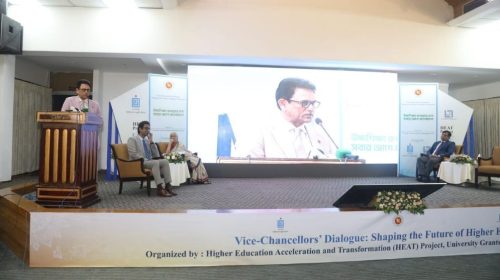
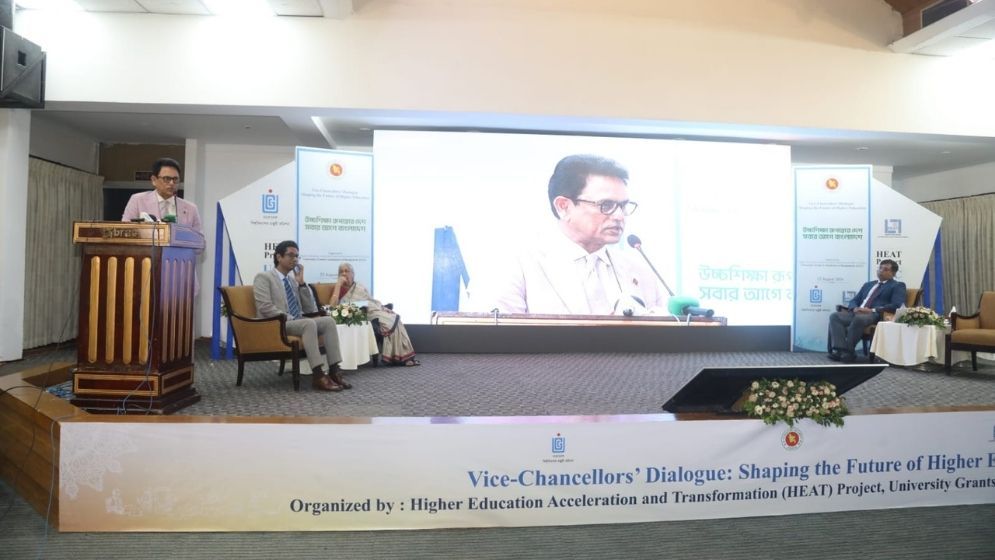
The education minister made the remarks while addressing the closing ceremony of a two-day Vice-Chancellors’ Dialogue as the chief guest at BRAC CDM in Savar on Saturday.
The dialogue was organised under the Higher Education Acceleration and Transformation (HEAT) project, implemented by the University Grants Commission (UGC).
The prime minister has expressed interest in establishing a postgraduate university in Bangladesh to encourage research and innovation, Milon said.
“The government will provide all kinds of support to develop new universities in line with global standards,” he added.
Stressing the need to overhaul the country’s education system to bring higher education up to international standards, Milon said university curricula must be updated in line with labour market demands.
“Employment prospects and future demand must also be considered when opening new departments,” he said.
He said the government might allocate 3% of GDP to the education sector next year.
The minister said some private universities in the country were failing to provide quality education.
“The UGC has been instructed to identify these universities,” he said, adding that the government had not yet taken the drastic decision to shut down substandard private universities, keeping students’ interests in mind.
Milon said the current government had not approved any new private university and instructed the UGC to take necessary steps to introduce PhD programmes at quality private universities.
Speaking as chair of the event, UGC Chairman Professor Dr Mamun Ahmed said the commission was working to bring the country’s higher education system up to international standards in line with the government’s priority sectors.
“A draft five-year strategic plan has been prepared after identifying the challenges facing higher education. It will be finalised based on feedback from stakeholders,” he said.
The UGC chairman said an initiative would be taken to introduce mandatory internships to familiarise students with the actual working environment of industrial and business organisations.
“The UGC will play the role of coordinator in this programme,” he said, adding that arrangements would also be made to provide students with necessary financial support during their internships.
On the second day of the dialogue, four sessions were held focusing on curriculum reform, student support and employability, financial and procurement management, the role of the HEAT project in transforming higher education, and strategic planning for higher education.
Comment
Design & Developed by: BD IT HOST


 |
22 Augustust, 2026
|
22 Augustust, 2026