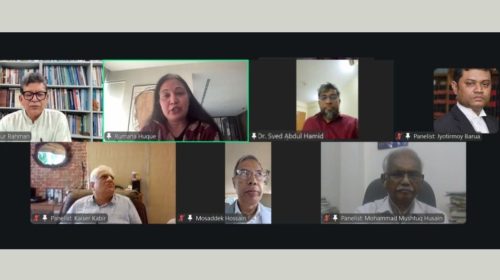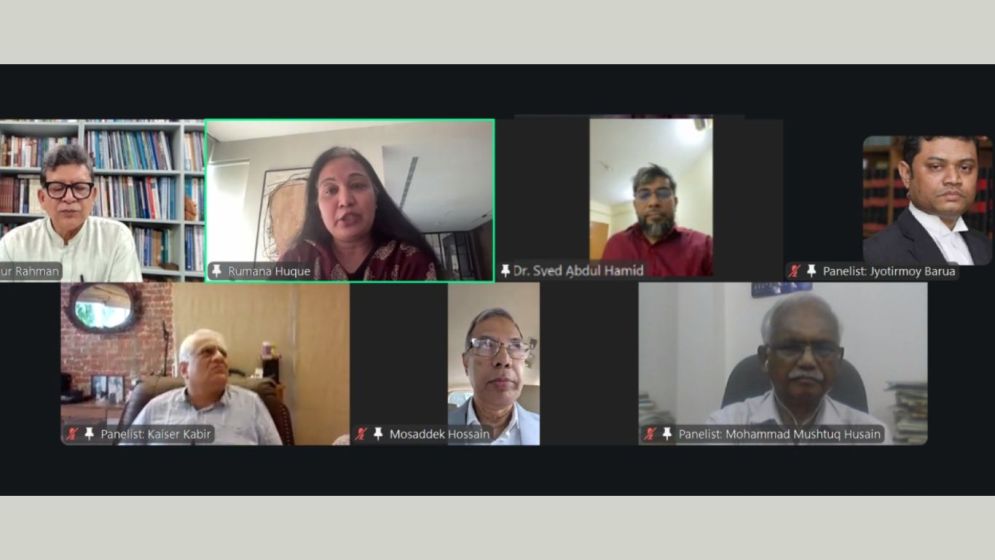
Bangladesh’s pharmaceutical pricing debate returned to the centre of public discourse as Power and Participation Research Centre’s Ajker Agenda webinar convened economists, industry leaders, legal experts, and public health specialists on Saturday to examine the tensions between affordability, market viability, and regulatory oversight in pricing of medicine.
Dr Syed Abdul Hamid of Institute of Health Economics at Dhaka University said, “Because medicine price adjustments are handled by government-led committees rather than an independent regulatory body, necessary updates are stalled out of fear of public backlash, unlike neighbouring countries that adjust prices routinely without political stigma. If we do not focus on R&D for the shift from generic to biologic medicines right away, we will see further exodus of domestic patients seeking treatment abroad,” according a press release.
Dr Rumana Huque of Economics department at DU said, “Essential Drugs Company Limited (EDCL) provided drugs worth Tk830 crore in FY21–22 meant for free distribution at public facilities. Yet, widespread shortages, especially in rural areas, force patients to buy medicines out-of-pocket, driving personal healthcare spending. There is also the problem of over-prescription and inappropriate and excessive use of antibiotics and vitamins”
Kaiser Kabir, CEO of Renata Limited said, “Medicine prices in Bangladesh remain among the lowest globally because intense local competition drives down supply chain costs. Direct price regulation simply does not work in our market structure. To ensure UHC, government should prioritise targeted procurement and subsidised distribution of medicines for critical care diseases such as cancer. “
Jyotirmoy Barua from Bangladesh Supreme Court raised concerns over the legal ambiguity underpinning current pricing rules and the state’s retreat from oversight.
He said, “Under the 1982 Drug Control Ordinance, the state maintained clear authority to regulate medicine pricing. Surprisingly, with the enactment of the Drugs and Cosmetics Act 2023, the government voluntarily curtailed its own oversight, indicating it would only regulate prices for a specific list of essential medicines, a list that has yet to even be published.”
Dr Mushtuq Husain, a public health expert, cautioned against discarding the existing pricing framework outright despite its imperfections.
He said, “While the 2026 drug and medicine pricing guidelines may not fully reflect every stakeholder’s input, that alone does not justify scrapping the framework entirely. Rejecting it outright is not the right approach.”
M Mosaddek Hossain, senior vice president of the Bangladesh Association of Pharmaceutical Industries, said, “Several drugs on the Essential Drugs List have vanished from the market due to prolonged negative margins. Prices for these essential products should be set through market competition among producers rather than static administrative controls. Ensuring availability and quality are two essential concerns.”
Moderating the session, PPRC Executive Chairman Hossain Zillur Rahman framed the pricing debate as part of a broader systemic challenge ahead of Bangladesh’s LDC graduation, emphasising the need for targeted government interventions to protect vulnerable populations.
“The medicine pricing debate reflects a broader systemic challenge we must address before losing IP exemptions post-LDC graduation, where targeted procurement for high-mortality non-communicable diseases can serve as a vital healthcare safety net on our path to Universal Health Coverage,” he said.
Comment
Design & Developed by: BD IT HOST


 |
22 Augustust, 2026
|
22 Augustust, 2026