The National Special Economic Zone on the shores of the Bay of Bengal in Mirsarai, Chattogram. It was low tide, with the water receding and the exposed sand glistening in the sunlight.
On the same shore stands Bashundhara Multi Steel Industries Ltd (BMSIL), a concern of Safwan Bashundhara Global. After entering through Gate No. 11 and walking along the embankment, a series of huge industrial structures comes into view—towering steel frames and rows of heavy machinery.
But here, too, it feels as though the tide has gone out.
There is one crucial difference. The sea would regain its tide within a few hours. At this factory, however, the industrial tide has been out for nearly two years—and there is still no sign of its return.
Beneath one of the huge steel structures stands a ladle car, motionless on tracks resembling a railway line. Weighing around 30 tonnes, the ladle car is designed to carry molten steel from one stage of the production process to another.
Yet it has never made its maiden journey along the track.
It has remained in the same place for four years.
According to engineers at the project, a single trip along the 25-metre track would facilitate the production of at least 100 tonnes of steel. With the ladle car expected to make at least 40 trips a day, the facility should have been capable of producing at least 4,000 tonnes of steel daily.
So why have the wheels of a machine that was ready to operate never turned?
An on-site investigation and a review of documents obtained by Kaler Kantho, alongside conversations with people involved in the project, point to a series of government decisions that project officials allege adversely affected the financing and production activities of major industrial projects following the political changeover in 2024.
Project officials allege that some decisions taken by the interim government led by Dr Muhammad Yunus restricted their normal banking operations, directly affecting production and new industrial projects.
They particularly allege that a series of decisions by Bangladesh Bank created complications in bank financing, loan rescheduling, letters of credit (LCs), raw material imports and syndicated loans for large projects.
They also allege that then Bangladesh Bank Governor Dr Ahsan H Mansur played a role in these decisions.
The problems, however, were not confined to this steel plant.
An investigation found similar financial and policy obstacles affecting several major projects of large industrial groups, including Bashundhara. Visits to several completed and under-construction industrial projects in Sonargaon, Narayanganj, and near Purbachal in Dhaka revealed a similar picture.
Some projects were fully ready but could not begin production. Others were stuck at the final stage of construction, while several existing factories were operating well below capacity.
People involved in the projects say thousands of crores of taka have been invested in these ventures. If fully operational, they could have created direct employment for 20,000 to 25,000 people and potentially generated livelihoods for at least 100,000 people directly and indirectly.
Higher production could also have reduced the country’s dependence on imported goods, increased government revenue and saved a substantial amount of foreign currency.
Silence replaces the roar of machinery and workers
Bashundhara Multi Steel Industries occupies around 90 acres at the National Special Economic Zone in Mirsarai.
Huge sheds, production units, towering steel structures and rows of machinery together form an enormous heavy-industry complex. Standing beside the sea, one might expect the facility to be bustling with steel production.
But a closer look reveals a very different reality.
Instead of a busy production floor, there is an idle and lifeless collection of machinery.
The plant was designed to produce high-strength steel wires and rods, as well as channels, angles and other products used in modern construction. Yet there is no sign of production activity.
Instead of the noise of workers and machinery, there is an unsettling silence.
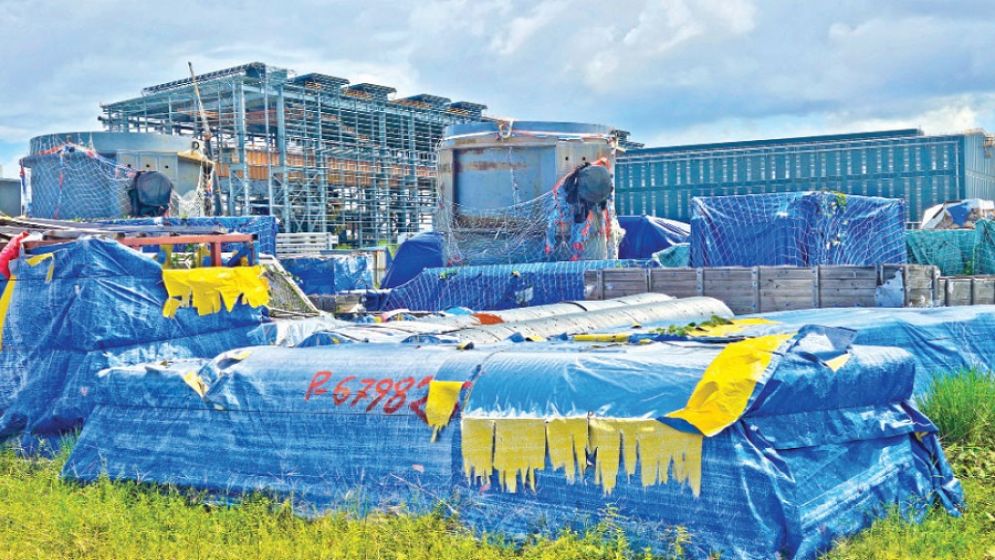
Walking further into the site, vast quantities of heavy machinery and components can be seen scattered in the open air.
They include scrap-shearing machines, overhead cranes, ladles, roll stands, FTP and LRPC equipment, transformers, mechanical and hydraulic systems, electrical drives and motors, and automation panels.
The same scene continues across acres of the site.
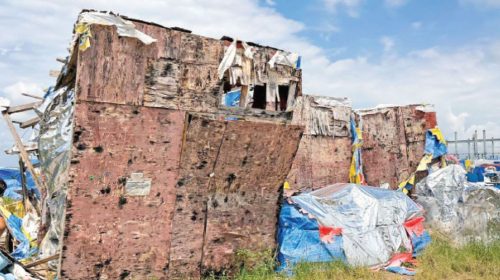
Some machinery is covered with blue tarpaulins, while other equipment remains inside wooden crates. After being exposed to sun, water and rain, many of the tarpaulins have torn and are hanging loosely. Wooden crates have deteriorated, while some machinery has begun to rust.
Sheikh Mohammad Rezwanul Ferdous, the project’s chief engineer, let out a long sigh.
“If production had started on time, this machinery would not be lying here,” he said.
Pointing towards the production unit, he added: “These machines are supposed to be installed under that structure. Once assembled, the wheels would have started turning. The entire area would have been filled with the sound of machines and workers. Various steel products would have been manufactured here. This area would have been used to store finished products and would have been bustling with workers.”
He said around 22 acres of the site had primarily been designated for scrap storage.
“Because production has not started, the machinery has been left waiting. We have spent nearly Tk2 crore just buying tarpaulins to protect the equipment. But because the machinery remains outdoors, the tarpaulins and insulation paper repeatedly become damaged.”
According to engineers, construction of the factory began in 2021. It is the largest investment project at the National Special Economic Zone and was designed to produce 1.25 million tonnes of steel annually.
As a single production unit, it was expected to become the country’s largest steel plant in terms of production capacity.
But with production yet to begin, around 19,000 tonnes of machinery and 20,000 tonnes of structural materials are effectively lying idle.
The further we walked through the facility with the engineers, the more striking the situation became.
Production was supposed to begin two years ago, which is why the necessary machinery and raw materials had been brought in well in advance.
Now weeds have grown around the site, with creepers climbing over machinery.
An on-site investigation also found that while this potentially significant green steel plant remained idle, a foreign-owned factory located nearby had already begun production.
Bangladesh’s steel demand outstrips domestic graded production
According to industry insiders, Bangladesh has an annual demand for around 7.5 million tonnes of steel products.
Against this, quality domestic plants currently produce around 4-4.5 million tonnes of graded steel.
Part of the remaining demand is met by smaller, less-regulated factories that produce non-graded steel.
By the middle or end of 2024, Bashundhara Multi Steel was fully prepared to begin production.
But project officials allege that the promising project was brought to a standstill amid the interim government’s actions.
As a result, the factory never started operating and production never began, leaving the company facing substantial financial losses.
The project was initially estimated to cost around Tk4,160 crore.
According to people involved, it could have created around 7,000 direct jobs and at least 100,000 direct and indirect employment opportunities.
According to the group’s estimates, the plant could have generated around Tk1,500-2,000 crore in government revenue annually once it reached full production.
Project officials say machinery worth around Tk534 crore imported for the plant became stranded at the port.
They claim that delays in clearing the machinery resulted in liabilities of around Tk950 crore, including demurrage and other charges.
Money ready, but machinery still not released
Documents obtained by Kaler Kantho show that letters of credit for importing capital machinery for the Mirsarai project were opened in early 2022.
At the time, the exchange rate was around Tk84-86 per US dollar.
As the LCs were confirmed, the relevant banks paid the foreign suppliers in full during 2022 and 2023.
But when the dollar exchange rate subsequently climbed to around Tk120, the value of the same machinery in local currency increased by roughly 40 per cent.
According to project officials, in early 2024 the bank demanded a one-off payment of around Tk850 crore from BMSIL to cover the foreign-exchange shortfall arising from the depreciation of the taka against the dollar on the already-settled LCs.
The project was still under construction and had no income at the time. Nor was the company allowed to draw additional funds under its approved credit facilities.
As a result, it took the company nearly a year to arrange the money.
By the end of February 2025, BMSIL had arranged the Tk850 crore.
The company also proposed paying the bank in exchange for the release of the original shipping documents. Once those documents were released, the machinery at Chattogram port could have been cleared and transported to the factory for installation.
But the situation changed the following month after a new directive.
According to documents, in March 2025 Bangladesh Bank instructed banks to treat all entities bearing the name “Bashundhara” as a single borrower.
Agrani Bank, the lead arranger of the syndicated loan, subsequently informed the company that releasing the shipping documents would increase its loan exposure to the single borrower beyond the applicable limit.
Other banks in the syndicate took the same position.
As a result, even though the foreign suppliers had already been paid and BMSIL had arranged the money demanded by the bank, the documents required to clear the machinery remained stuck with the banks.
Project officials claim Bangladesh Bank’s Credit Information Bureau (CIB) records identified BMSIL as a separate company from other entities.
They also say the CIB records contained no financial liabilities linked to other entities.
Legal documents, ownership records and board resolutions demonstrating the company’s separate corporate status were submitted to the banks and the regulatory authorities, they said.
Eventually, in April 2026—around 13 months later—Bangladesh Bank, after reviewing the relevant information, instructed Agrani Bank to treat BMSIL separately and outside the scope of the earlier directive.
By then, however, demurrage and container detention charges on the machinery stranded at the port had multiplied.
Interest on loans had continued to accrue.
The machinery that was supposed to generate revenue through production had instead become a source of fresh liabilities every day.
Only a quarter of syndicated loan disbursed
A consortium of eight banks led by Agrani Bank had approved a Tk2,350 crore syndicated term loan for the project.
According to documents, only Tk576 crore—or 24.51 per cent—had been disbursed.
With the remaining Tk1,774 crore not released, financing for the project effectively stalled at the final stage of construction.
A project official said: “The foreign suppliers had already been paid. The company had also arranged the money demanded by the bank. Yet the machinery remained at the port because the shipping documents were not released. Demurrage continued to increase every day, while interest on the loan also kept accruing.”
How did the deadlock begin?
An investigation into why one industrial project after another became stalled brought to light an important decision dating back to 2017.
A document shows that, following Bangladesh Bank approval in March that year, Bashundhara Group’s businesses began operating under five separate corporate structures.
These were Bashundhara Group (BG), Tanvir Bashundhara Group (TBG), Sanvir Bashundhara Group (SBG), Anvir Bashundhara Group (ABG) and Safwan Bashundhara Global (SBG).
People familiar with the matter allege that after the political changeover in 2024, Bangladesh Bank effectively began disregarding this separation.
Loans, liabilities and assets belonging to the five separate corporate structures were allegedly considered collectively.
This created significant complications over single-borrower exposure limits, credit ratings and access to new loans and LC facilities, they claim.
The situation became even more complicated following several subsequent decisions.
According to group officials, an application to reschedule a loan of around Tk850 crore at a bank was rejected, access to new credit facilities became restricted, and some bank accounts belonging to the group and its owners were suspended.
The biggest impact of these decisions was felt in the opening of letters of credit.
Senior Bashundhara Group officials allege that these were not isolated banking decisions.
They claim that, under the guise of ordinary banking risk management, a series of decisions were taken that ultimately restricted the group’s normal financing and import operations.
Their allegations are directed at policymakers in the then interim government and, in particular, then Bangladesh Bank Governor Ahsan H Mansur.
When will the machines finally start turning?
As we left Mirsarai, the tide had returned to the Bay of Bengal.
Much of the sandbar that had emerged in the morning was once again under water.
But the scene on the other side of the embankment had not changed.
The 30-tonne ladle car was still standing motionless on the same track.
The enormous production unit remained silent, while machinery continued to lie exposed to the elements, waiting.
On the way back, we spoke to an official working at a factory inside the special economic zone.
Alamgir Hossain, who is in his forties, said allegations of irregularities against any industrial enterprise should certainly be investigated.
“But if the wheels of production are stopped, it will not only hurt the national economy. Local people will also be deprived of new employment opportunities,” he said.
Alamgir said many people in Mirsarai remain unemployed.
“People here had dreamed of a new life after the National Special Economic Zone was established. But the way Bashundhara’s factories have been kept blocked has left local people disappointed. If these factories became operational, the local economy would also benefit.”
After speaking to Alamgir, we resumed our journey.
The sea and the vast industrial zone gradually disappeared behind us.
The tide had returned to the Bay of Bengal.
Now the question remains:
When will the industrial tide return? When will the machines finally start turning?
Comment
Design & Developed by: BD IT HOST


 |
24 Augustust, 2026
|
24 Augustust, 2026