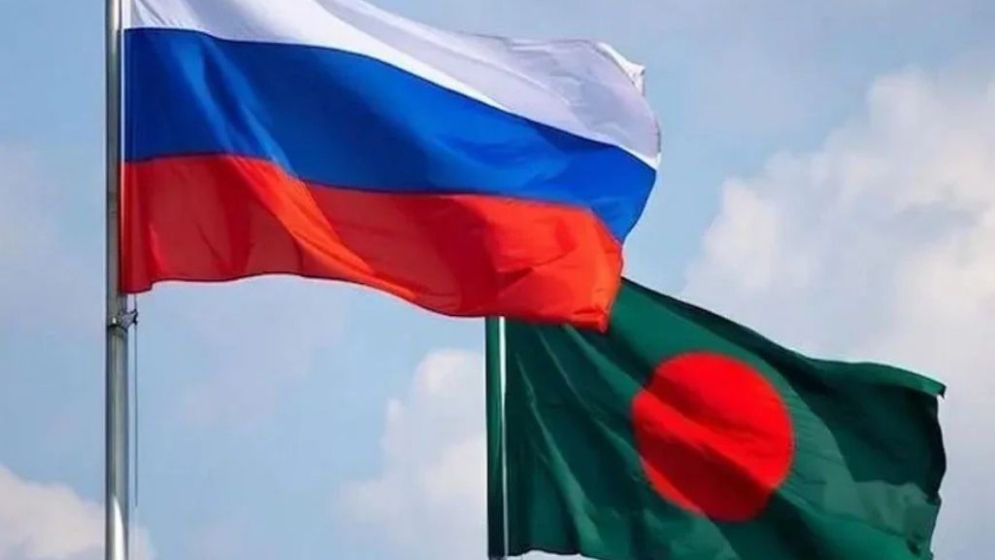
Russia has proposed settling bilateral trade with Bangladesh in Indian rupees, establishing a dedicated payment system and opening a branch of a Russian bank in Dhaka to overcome transaction difficulties caused by US sanctions on Russian banks.
Officials at the Economic Relations Division (ERD) said the proposals will feature prominently at the next meeting of the Bangladesh-Russia Intergovernmental Commission on Trade, Economic, Scientific and Technical Cooperation, expected in September or October.
The ERD is scheduled to hold a preparatory meeting today to finalise Bangladesh’s agenda for the bilateral talks.
Alternative payment system
According to ERD officials, Russia proposed using Indian rupees for bilateral trade after US sanctions imposed following the Russia-Ukraine war disrupted conventional banking channels.
Moscow also wants to establish a bilateral payment mechanism to facilitate transactions and has renewed its proposal to open a Russian bank branch in Bangladesh.
Russia made a similar proposal during the previous Awami League government, but the initiative stalled after Bangladesh Bank sought the opinion of the Ministry of Foreign Affairs.
Bangladesh has struggled to transfer loan repayments for the Russian-financed Rooppur Nuclear Power Plant because sanctions have blocked transactions with Russian banks. Russia initially proposed repayment in Chinese yuan, but banks in both China and Bangladesh reportedly declined to process the payments over concerns about possible US sanctions.
As a temporary arrangement, Bangladesh has deposited loan instalments into a Russian account at Sonali Bank, although sanctions have prevented the funds from reaching Russian banks.
Officials noted that Russia and India already conduct part of their bilateral trade in Indian rupees, while Bangladesh also uses the Indian currency alongside the US dollar for some trade with India.
Trade and investment
Russia has also proposed expanding bilateral trade by establishing a Russia-Bangladesh Business Council, creating a registry of reliable Bangladeshi textile suppliers for Russian importers, strengthening cooperation between small and medium-sized enterprises, and supporting the development of special economic zones.
Before the Russia-Ukraine war, Bangladesh exported more than $500 million worth of goods to Russia annually. According to Export Promotion Bureau data, exports fell to $245 million during the July-May period of the current fiscal year.
Bangladesh continues to import fertiliser, wheat and other commodities from Russia.
Bangladesh’s priorities
ERD officials said Bangladesh will prioritise technology transfer during the upcoming commission meeting.
Dhaka will also seek stronger cooperation in renewable energy, power generation, the digital economy, innovation, agriculture, food security, agro-processing, technical education, skills development, connectivity and logistics.
Russia offers discounted urea
Separately, Russia has reaffirmed its commitment to strengthening Bangladesh’s food security and expanding bilateral trade.
During a meeting at the Secretariat, a Russian delegation led by Chargé d’Affaires Vyacheslav Sentyurin offered to supply about 280,000 tonnes of urea fertiliser to Bangladesh Chemical Industries Corporation under a government-to-government arrangement at $10 per tonne below prevailing international market prices.
The two sides also discussed expanding cooperation under the existing memorandum of understanding between the Trading Corporation of Bangladesh and JSC FEC Prodintorg for supplying essential commodities.
Russia also expressed interest in exporting sunflower oil, yellow peas, chickpeas, red lentils and green lentils to Bangladesh.
Commerce Minister Khandakar Abdul Muqtadir welcomed Russia’s interest in expanding bilateral trade and said Bangladesh remains committed to strengthening trade, investment and economic cooperation on the basis of mutual benefit.
Comment
Design & Developed by: BD IT HOST


 |
12 Septembertember, 2026
|
12 Septembertember, 2026