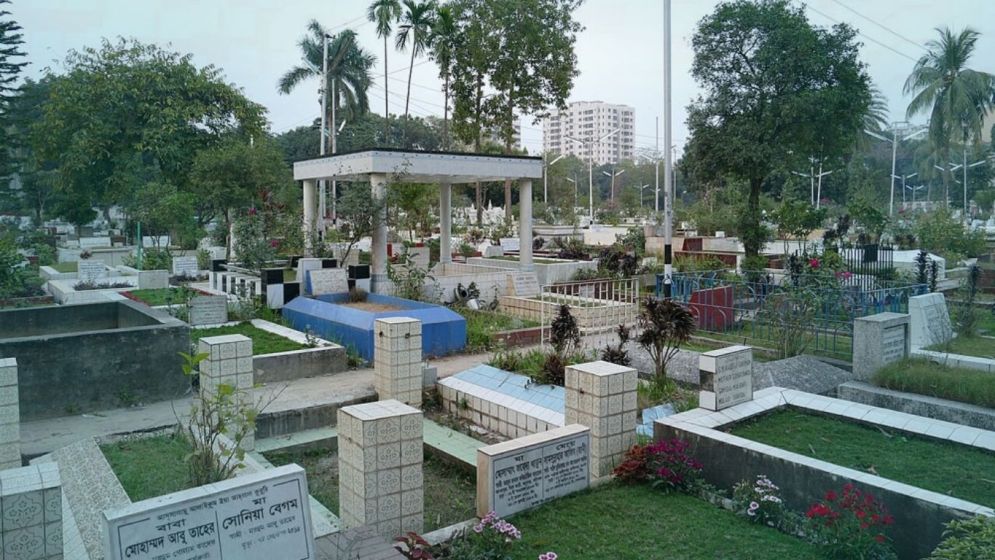
A 20-square-foot burial plot in the capital’s upscale Banani area now costs nearly Tk4.5 crore to reserve for 25 years — almost the price of a 2,000-square-foot flat.
According to a report by Bonik Barta, a severe shortage of burial space has persisted at the Banani graveyard, which is managed by Dhaka North City Corporation. There is hardly any scope to create new space, forcing authorities to reuse old graves for new burials.
Sources familiar with the graveyard said reserving a grave for 15 years costs around Tk3 crore, while the cost rises to nearly Tk4.5 crore for 25 years. The prescribed fee for reusing a permanent grave for a new burial is Tk50,500.
Many people visit the Banani graveyard every day looking for burial space. Some want to arrange a grave in advance for relatives, while others want to secure their own final resting place. But most leave disappointed because of the shortage of space.
Sixty-five-year-old Shahidul Alam of the Banasree residential area has been searching for a burial plot at different graveyards for several years.
“I want to buy a burial plot for myself before I die. I was even willing to pay Tk4-5 crore. But I still cannot find a plot measuring three and a half cubits,” he said.
An employee at the Banani graveyard said around 10 to 12 people come every day looking for burial space. Although many are willing to pay, the authorities cannot assure them of a plot because of the shortage of space.
Banani graveyard Moharrar Harunur Rashid said there are more than 9,000 graves there. As there is no room for expansion, old graves are being reused.
“After two years, another grave is made over an existing one. In some permanent graves, as many as seven people have been buried,” he said.
Like Banani, Azimpur graveyard, one of the largest in the capital, is also facing a severe shortage of space. The nearly 32-acre graveyard has around 30,000 graves, while an average of 25 to 30 people are buried there every day.
Usually, a body remains in a grave for around 18 months before the grave is reused when necessary.
Moharrar Rabiul Islam said there is a provision for depositing money to reserve graves for longer periods, but thousands of applications remain pending because of the shortage of space.
Urban planners say the number of graveyards in Dhaka has not increased in line with the city’s rapid urbanisation and population growth.
They said urban plans allocate space for housing, roads, commercial establishments, education and healthcare, but lack long-term planning to meet the future demand for burial grounds.
Prof Dr Akhtar Mahmud, former president of the Bangladesh Institute of Planners, said graveyards are also an important urban service.
“But with the expansion of Dhaka, space for this emotional and essential need of people is shrinking,” he said.
He said the high fees for reserving graves were mainly a result of the shortage of space. In many countries, graveyards are also used as community spaces, he added.
RAJUK Chief Urban Planner Md Ashraful Islam said the need for graveyards in Dhaka should now be discussed afresh.
“The trend of burials in the capital may increase further over the next 20 years,” he said.
According to the Private Land Development Rules, one acre of burial ground is required for every 50,000 people. If Dhaka’s population is around 3.5 crore, the city may need nearly 700 acres of burial grounds.
The Detailed Area Plan (DAP) has also recommended establishing small graveyards in every ward.
Comment
Design & Developed by: BD IT HOST


 |
12 Septembertember, 2026
|
12 Septembertember, 2026