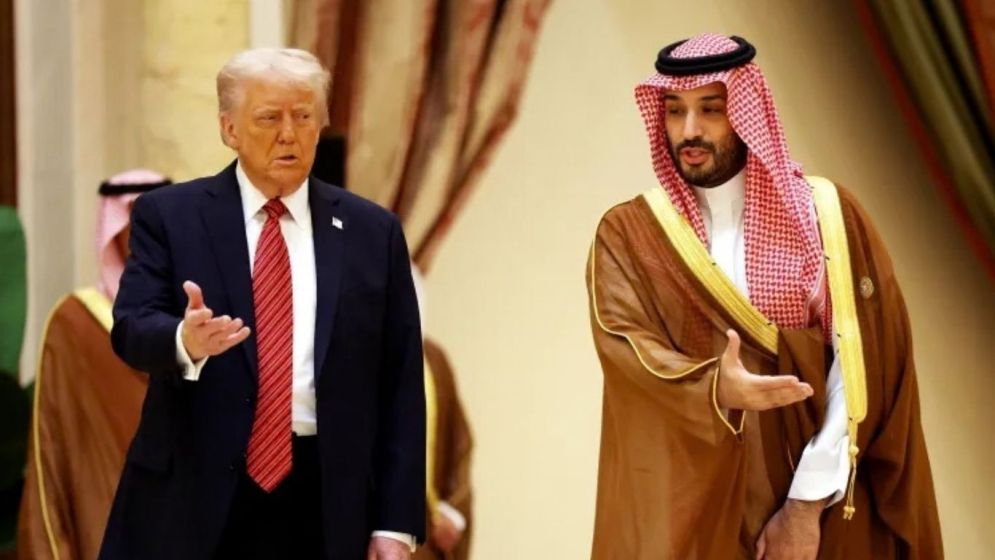
Saudi Crown Prince Mohammed bin Salman sought military assistance from President Donald Trump on Thursday to help fight Yemen’s Iran-aligned Houthis, three sources familiar with the matter said on Friday, as the Houthis stepped up their threat to the Red Sea.
Trump held at least two phone conversations with the Saudi leader on Thursday and did not agree to the U.S. striking Houthis, the sources said. Washington told Riyadh that it would help with intelligence sharing and targeting, they added.
The White House did not address a Reuters question on whether there were any phone calls between the two leaders, but a senior administration official speaking on the condition of anonymity said Washington was in continuous dialogue with Saudi Arabia and the Yemeni government.
“The United States is focused on protecting our core national security interests — such as ensuring freedom of navigation in the Red Sea — while empowering our regional partners to take the lead in managing and resolving regional security challenges,” the official said.
The Saudi government media office did not immediately respond to a request for comment on the phone calls and on conversations between the two leaders.
Admiral Brad Cooper, commander of U.S. Central Command, traveled to Saudi Arabia on Thursday for talks, two of the sources said.
News of the request to Trump was first reported by Axios.
SAUDI APPEAL MARKS CHANGE OF APPROACH
The U.S. war with Iran has entered its seventh month with no immediate end in sight. The war has driven up prices of global oil and U.S. gasoline, sending Trump’s approval ratings to a record low before the November midterm elections.
The Iran-backed Houthis have staged a dramatic advance down Yemen’s Red Sea coast in recent days, reaching the strategic island of Perim in the Bab el-Mandeb Strait on Friday, four Yemeni government sources told Reuters.
Houthi control of the Red Sea’s Bab el-Mandeb Strait, which is on the opposite side of the Arabian Peninsula from the Strait of Hormuz, could give Iran a critical advantage in its war with the U.S., reducing supplies through a second major transit corridor and sending oil prices surging.
Saudi Arabia, the world’s largest oil exporter, has relied on the Red Sea route since the Iran conflict effectively closed Hormuz, through which a fifth of global oil used to flow.
The escalation between the Houthis and Riyadh dates back to early July, when Houthi forces confronted what they said were Saudi warplanes attempting to prevent an Iranian civilian aircraft from landing at Yemen’s Sanaa International Airport. That exchange of fire broke a four-year truce in the conflict between the kingdom and the Iran-aligned group.
Saudi Arabia told the United States in July that it could fight the Houthis on its own and emphasized to Washington that the war should not escalate, according to a fourth person familiar with the matter. Saudi officials urged their U.S. counterparts to increase economic pressure on Iran.
A former senior U.S. official familiar with current developments said the Saudi leader’s Thursday outreach to Trump was to see if the U.S. could increase its pressure on the Houthis militarily, instead of Riyadh having to confront the group alone. “So far, they’ve been told no, but watch that space,” the official said.
The U.S. and Israel attacked Iran on February 28 and Iran responded with its own strikes on Israel and Gulf states that host U.S. bases. U.S.-Israeli strikes on Iran and Israeli attacks on Lebanon have killed thousands and displaced millions.
Comment
Design & Developed by: BD IT HOST


 |
12 Septembertember, 2026
|
12 Septembertember, 2026