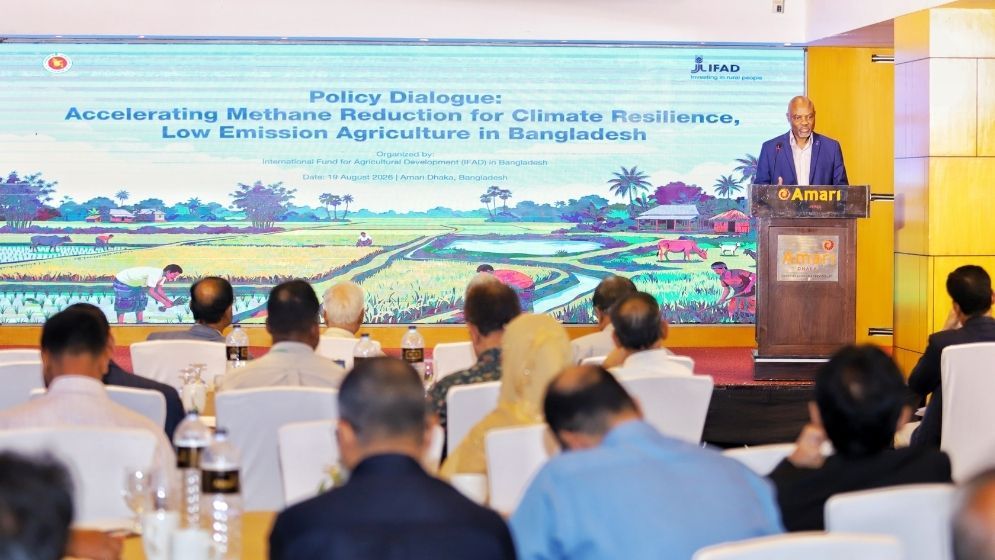
The International Fund for Agricultural Development (IFAD) on Wednesday called for stronger government leadership to turn growing knowledge on agricultural methane reduction into policies, programmes and investments for climate-resilient and low-emission agriculture in Bangladesh.
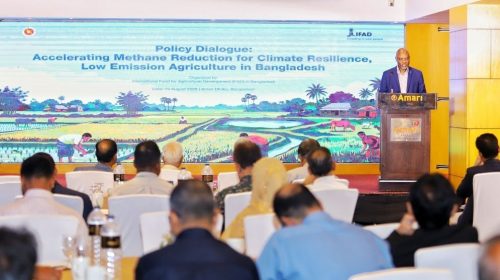
The call came at a policy dialogue titled “Accelerating Methane Reduction for Climate Resilience and Low-Emission Agriculture in Bangladesh”, organised by IFAD at Amari Dhaka.
Government representatives, researchers, development partners, international financial institutions, civil society representatives, private-sector actors and farmers’ representatives attended the event to discuss how evidence and technologies could inform national agricultural planning, investment and implementation.
Mostafa Kamal, additional secretary to the Ministry of Agriculture and chief guest at the event, stressed the importance of knowledge in strengthening future agricultural interventions.
“IFAD is our trusted, long-standing partner. Beyond its investments, IFAD brings a global and tested knowledge base in agriculture and agroecology. We need to draw on this knowledge and translate it into interventions that provide a solid foundation for the development of our country,” he said.

He also highlighted the links between land, life and livelihoods, saying agricultural interventions should respect ecological balance while responding to farmers’ realities.
Valantine Achancho, IFAD country director for Bangladesh, stressed the need to move beyond isolated initiatives.
“Government must lead, partners must coordinate around that leadership. Our collective objective should be one coherent national pathway, not a collection of disconnected pilots,” he said.
“The evidence is growing. The technologies are increasingly available. The partners are present. What is needed now is alignment, policy commitment and investment on a scale under the leadership of the Government,” he added.
The dialogue examined several approaches to reducing agricultural methane emissions, including alternate wetting and drying, urea deep placement, smart irrigation, digital agriculture and livestock methane reduction. Participants also discussed climate finance, carbon markets and credible measurement, reporting and verification systems.
A panel comprising representatives from the Food and Agriculture Organisation of the United Nations, Department of Environment, Department of Agricultural Extension, Bangladesh Agricultural University and Bangladesh Rice Research Institute discussed development-partner coordination, implementation of Nationally Determined Contributions, frontline extension needs, emissions measurement and verification, and the links between methane reduction and food security.
Participants also took part in four thematic breakout sessions focusing on methane-reduction technologies, climate finance and carbon markets, digital agriculture and IoT-enabled irrigation, and extension models for climate-smart agriculture.
The dialogue builds on IFAD’s Reducing Agricultural Methane Programme, which has supported technical capacity development, applied research, policy engagement and field demonstrations in Bangladesh.
As the programme’s current phase concludes, IFAD stressed the need for actionable recommendations, a government-led roadmap, stronger delivery systems, credible mechanisms for measuring and verifying emission reductions, investment pathways and improved coordination among institutions.
Comment
Design & Developed by: BD IT HOST


 |
19 Augustust, 2026
|
19 Augustust, 2026