Artificial intelligence (AI) could offer a new way to tackle Dhaka’s chronic traffic congestion by making urban transport planning more data-driven, responsive and user-focused, according to a Chinese transport researcher.
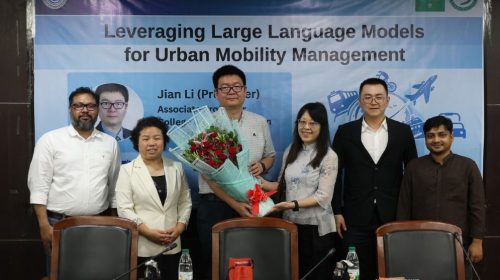
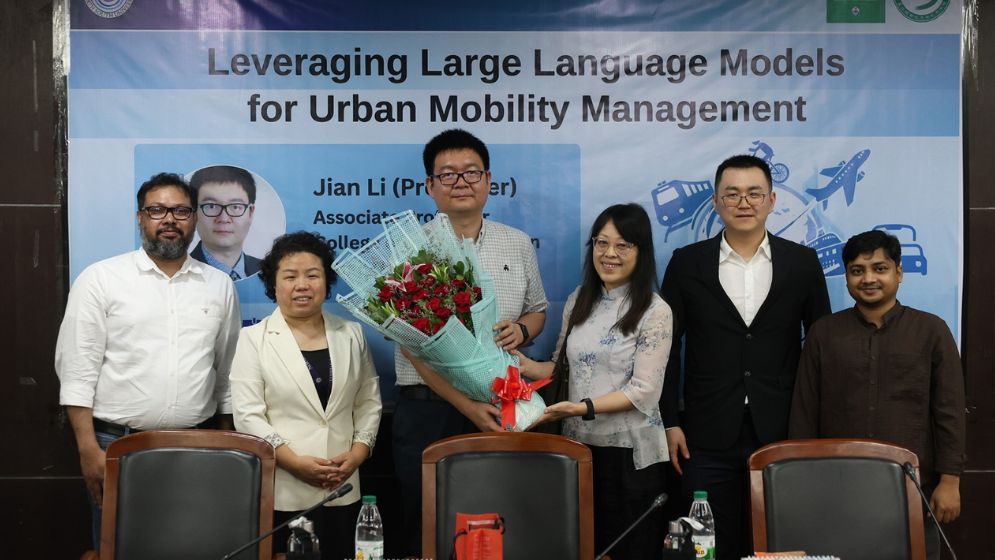
Dr Qian Li, an associate professor at Tongji University in Shanghai, presented his latest research on the use of large language models (LLMs) in urban transport management at seminars held at North South University and the University of Dhaka earlier this month.
His research explores how transport systems can move beyond conventional traffic engineering towards AI-driven and user-centred urban mobility.
At the centre of his approach is a four-layer framework known as Data + Knowledge Graph (KG) + Model + Task, which combines mobility data, specialised knowledge, AI models and specific transport tasks to support transport planning and decision-making.
Traditional traffic engineering generally relies on vehicle counts, signal timing and road design. Dr Li’s approach seeks to complement these methods with big data and AI to better understand travel patterns and respond to changing passenger needs.
One major area of his research is urban mobility analysis, which uses mobile phone location and movement data to identify people’s daily travel patterns. Such information can help authorities make better decisions on transport infrastructure and services.
His research also covers sustainable and green transport, including electric bus management, carbon-emission measurement and low-carbon mobility planning.
He has also explored the use of blockchain technology to improve transparency in the transportation of hazardous goods and coordination among different agencies.
Dr Li’s research has been applied to urban transport challenges in Shanghai and other major cities. Among his notable work is the use of citizen hotline data to identify transport problems and improve public bus services.
He has also developed a knowledge-enhanced AI system to address a key weakness of general-purpose LLMs, which can sometimes generate inaccurate or fabricated information.
The system combines textbooks, government policies and research reports from Shanghai’s transport sector into a knowledge graph. When integrated with retrieval-augmented generation technology, it can provide more reliable information on specific bus routes and express services.
At the Dhaka seminars, Dr Li stressed that developing smart transport systems requires cooperation among universities, research institutions and public and private technology companies.
For Dhaka, the framework could potentially support traffic management, bus route rationalisation and the integration of feeder bus services with the metro rail network.
By combining mobile mobility data with citizen feedback, AI could help planners develop more targeted and cost-effective transport policies for the capital.
Dr Li earned a PhD in Civil and Environmental Engineering from Rutgers University in the United States and later worked as a postdoctoral research associate at The Hong Kong Polytechnic University. He joined Tongji University in 2014 and has conducted research in traffic engineering, transport planning, big data and artificial intelligence.
According to his ResearchGate profile, he has published more than 52 research papers, received over 855 citations and recorded more than 10,000 reads.
Comment
Design & Developed by: BD IT HOST


 |
19 Augustust, 2026
|
19 Augustust, 2026