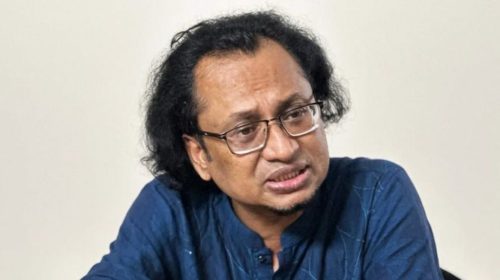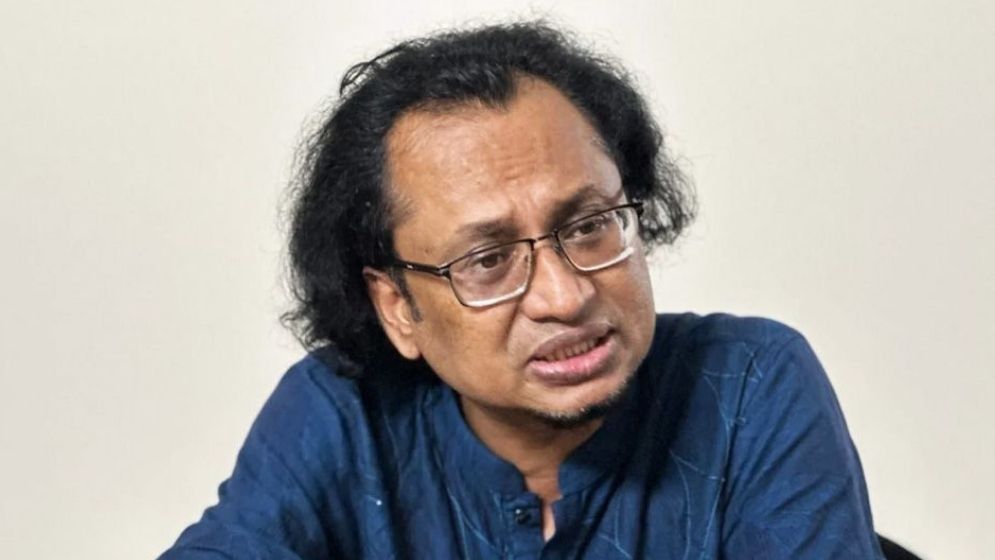
Prime Minister’s Information and Broadcasting Adviser Zahed Ur Rahman has expressed hope that the power shortage and load-shedding situation caused by the ongoing gas supply crisis in the country will gradually improve.
He said a major shortfall in gas supply had emerged following an accident involving a floating liquefied natural gas (LNG) terminal.
However, as the terminal gradually resumes normal operations, the gas shortage is expected to ease in phases, leading to an improvement in the overall power situation.
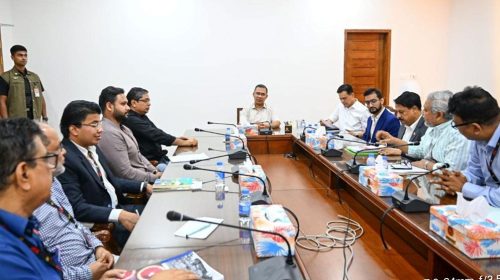
The information adviser expressed this optimism while highlighting the recent activities of various ministries at a press conference held at the Secretariat on Tuesday (4 August).
The information adviser said people in vast areas outside Dhaka have been suffering severely due to intense load-shedding and power shortages.
He said the situation has made life extremely difficult for ordinary people amid the scorching heat. The government is fully aware of the public suffering and is making every possible effort to address the crisis.
He said Bangladesh’s daily gas demand is around 3,800 million cubic feet, but it has not been possible to supply that amount of gas for a long time.
The country has become dependent on LNG to make up for the shortfall in domestic gas production. LNG is imported from abroad, regasified at terminals and then supplied to the national gas grid.
The information adviser said that a fire recently broke out at one of the country’s two floating LNG terminals, which is operated by an international company.
Although the incident was not major, the terminal is currently unable to operate at full capacity. As a result, gas supply to the national grid has declined significantly.
He said the impact of the shortfall has extended beyond power generation to industries, households and compressed natural gas (CNG) filling stations.
Due to low gas pressure in many areas, people are unable to carry out their regular cooking activities.
Many captive power plants at industrial establishments have either been shut down or are operating at limited capacity due to the gas shortage. As a result, these industries have become more dependent on the national power grid, further increasing electricity demand.
He further said the government has kept costly diesel-fired power plants in operation to manage the situation. Such plants are generally used on a limited scale because of their high generation costs.
However, despite bearing additional costs in the public interest, the government is trying to increase power generation during the current crisis. Even then, load-shedding could not be avoided in some areas.
The information adviser said he had discussed the matter with the minister and state minister responsible for the power and energy sectors.
According to information received from the authorities concerned, the affected LNG terminal will gradually resume gas supply.
Supply will be increased in phases rather than being restored to full capacity at once. As a result, additional pressure on electricity demand is expected to decrease, and both the gas and power crises are likely to ease gradually.
Dr Jahed Ur Rahman said the current crisis cannot be viewed solely as an internal problem. Volatility in the international energy market is also one of the major contributing factors.
Following the Russia-Ukraine war, European countries reduced their dependence on Russian pipeline gas and shifted heavily towards LNG. This led to an increase in both global demand for and prices of LNG.
He said the ongoing geopolitical instability in the Middle East has made the situation even more uncertain.
Any disruption to major global energy transport routes could have a significant impact on both energy supplies and prices in the international market. Bangladesh would also not be completely immune to these effects.
The information adviser said the government is working not only to address the immediate crisis but also to ensure long-term energy security.
Gas exploration activities onshore have been expanded. At the same time, initiatives have been taken to increase the use of renewable energy, particularly solar power.
Work is progressing to implement solar power projects at government buildings and various other facilities. However, it will take time for these projects to deliver benefits.
He said discovering new gas fields offshore or onshore and starting production from them is a long-term process. Therefore, some time will be needed to fully overcome the current crisis.
He urged people to remain patient and become more conscious of the efficient and economical use of electricity and energy.
Dr Zahed Ur Rahman said the government is working to strengthen the country’s energy system by developing alternative supply arrangements, increasing backup capacity and reducing dependence on imported energy.
Expressing optimism, he said gas supply would increase as the LNG terminal returns to normal operations, and the current crisis is expected to ease gradually within the next few days.
Comment
Design & Developed by: BD IT HOST


 |
5 Augustust, 2026
|
5 Augustust, 2026