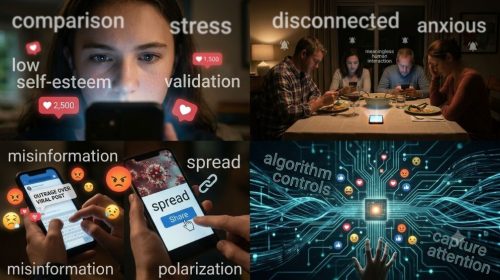
There are moments in the history of civilization when humanity does not merely advance into a new era, but is compelled to redefine itself.
The invention of agriculture changed the question of human survival. The industrial revolution changed the question of human productivity. The digital revolution changed the question of human connection. The artificial intelligence revolution is now changing the most fundamental question of all: What is the place of humanity in a world increasingly shaped by intelligent systems?
Every great transformation has challenged humanity to adapt. However, the present transformation is different in one profound way. Previous technologies expanded what human beings could do with their hands. Artificial intelligence expands what human beings can accomplish through systems that increasingly interact with knowledge, reasoning and creativity.
Humanity has entered an age where its own creations are beginning to participate in functions once considered uniquely human. This is not simply the arrival of a new technology. It is the beginning of a new relationship between humanity and intelligence itself.
The significance of this moment extends far beyond laboratories, corporations or digital platforms. It reaches into the deepest foundations of society. It will influence how people learn, work, govern, communicate and understand their own identity.
The central challenge of the twenty first century is therefore not technological advancement alone. The central challenge is ensuring that human progress remains connected with human wisdom.
The Long Journey of Human Civilization
The history of civilization can be understood as humanity’s continuous effort to overcome limitations.
The earliest human communities struggled against the limitations of nature. Agriculture allowed humanity to create stability from uncertainty. It transformed survival into settlement and created the foundations of organized society.
The great civilizations of history emerged from this transformation. They developed systems of law, philosophy, architecture, literature and governance. They demonstrated that civilization was not merely the accumulation of wealth, but the creation of meaning.
The industrial revolution introduced another transformation. Machines multiplied human physical capability and created unprecedented economic growth. However, it also taught humanity an important lesson: progress without ethical responsibility can create new forms of inequality and social tension.
The digital revolution created a world where information became almost limitless. It democratized knowledge and connected humanity in ways previously unimaginable. Yet it also revealed new challenges involving misinformation, privacy, attention and social trust.
Each revolution expanded human capability. Each revolution also demanded greater human responsibility. Artificial intelligence represents the next stage of this historical journey. It asks humanity not only how powerful it can become, but how wisely it can use that power.
Generation Z: The First Citizens of the Intelligent Age
Generation Z stands at the centre of this transformation because history has placed them at the beginning of the intelligent age. They are the first generation to experience technology not as an external invention, but as an integral part of daily existence.
They have grown up in a world where information is immediate, communication is global and digital identity exists alongside physical identity. For earlier generations, technology represented change.
For Generation Z, technology represents the environment in which change occurs. This gives them a unique understanding of the modern world. They are naturally familiar with digital platforms, global networks and rapidly evolving technologies.
But familiarity does not automatically create wisdom. The greatest responsibility of Generation Z is not merely to become skilled users of technology.
It is to become thoughtful guardians of technology. They must ask questions that previous generations could not fully anticipate. How can societies preserve human dignity when machines become increasingly capable?
How can individuals maintain authenticity in an age of artificial influence? How can humanity ensure that efficiency does not replace empathy? These are not merely technological questions. They are questions about civilization itself.
Beyond Artificial Intelligence: The Search for Human Wisdom
The world often discusses artificial intelligence in terms of capability. How fast can it calculate? How accurately can it predict? How creatively can it generate?
These questions are important, but they represent only one dimension of the future. A more profound question must also be asked:
What qualities should remain at the centre of human civilization? Intelligence without wisdom can become dangerous. Knowledge without responsibility can become destructive. Power without morality can become uncontrollable.
Human history provides countless examples of societies that possessed extraordinary knowledge but struggled to use that knowledge responsibly.
The future therefore requires a broader understanding of intelligence. The highest form of intelligence is not simply the ability to solve problems. It is the ability to understand consequences.
It is the ability to recognise human suffering. It is the ability to choose responsibility even when convenience suggests otherwise. Machines may become extraordinary at processing information. Human beings must become extraordinary at understanding meaning.
The Transformation of Education and Human Potential
The education systems of the future must also experience a profound transformation. For generations, education was built around the acquisition of information. Students were trained to remember knowledge, reproduce answers and develop specialised skills.
However, in an age where information is available instantly and machines can assist with complex analysis, education must move toward something deeper. The purpose of education must become the development of human capability.
Future education must cultivate curiosity, creativity, ethical reasoning and emotional intelligence. The most valuable individuals of the future will not simply be those who know the most facts.
They will be those who can ask the most meaningful questions. They will be those who can connect different fields of knowledge.
They will be those who can combine technology with imagination and innovation with responsibility. Generation Z has the opportunity to become the first truly multidisciplinary generation, capable of combining science with philosophy, technology with humanity and innovation with ethics.
Technology, Democracy and Global Responsibility
The future of artificial intelligence will also become inseparable from the future of democracy.
Technology has always influenced the distribution of power. The printing press transformed political awareness. Industrialization transformed economic structures. The internet transformed communication.
Artificial intelligence will influence decision-making itself. It will affect governments, institutions, businesses and societies. Therefore, the governance of artificial intelligence cannot be left only to technical experts or commercial interests.
It requires global ethical leadership. The future will need leaders who understand that innovation must serve humanity rather than control humanity. They must ensure that technology protects freedom, strengthens opportunity and respects human dignity.
A truly advanced civilization is not one where machines become more powerful than people. A truly advanced civilization is one where technology allows people to become more fully human.
The Responsibility of the Human Generation
Generation Z has inherited both the greatest technological opportunity and one of the greatest moral responsibilities in human history. They have access to tools capable of transforming education, medicine, science, business and global cooperation.
But they must decide what purpose those tools will serve. Will technology deepen division or create understanding? Will artificial intelligence replace human responsibility or strengthen human potential? Will the future become merely faster, or will it become wiser?
These questions cannot be answered by machines. They require human judgment. The destiny of civilization will not be determined by algorithms alone. It will be determined by the values that guide those algorithms.
The Final Choice of Civilization
Humanity now stands before a historic choice. One path leads toward a future where technological capability grows faster than ethical understanding, where societies become increasingly dependent on systems they cannot fully control.
The other path leads toward a future where technology becomes a partner of human advancement, where intelligence is guided by compassion and where innovation serves the dignity of every individual.
Generation Z will influence which path humanity follows. They are not simply inheritors of the future. They are architects of the future.
Their greatest achievement will not be the creation of more advanced machines. Their greatest achievement will be ensuring that humanity remains worthy of the power it has created.
Civilizations are remembered for the monuments they build, the ideas they preserve and the values they choose to defend. Generation Z will be remembered for something greater.
It will be remembered for deciding whether humanity remained the author of its future or became merely the audience of its own inventions. History has opened a new chapter. The pen now rests in the hands of the Human Generation.
The Promise of the Human Future
The measure of a generation is never determined only by the circumstances it inherits. It is determined by the courage with which it responds to those circumstances.
Every generation receives unfinished history. Some inherit the responsibility of rebuilding after destruction. Some inherit the responsibility of expanding knowledge. Some inherit the responsibility of protecting values that took centuries to establish.
Generation Z inherits perhaps the most profound responsibility of all: the responsibility of preserving humanity at the very moment when humanity has created powers that could redefine its own existence.
The future will not ask this generation whether it possessed the most advanced technology. It will ask whether it possessed the deepest wisdom. It will not ask only how efficiently it created. It will ask how responsibly it created. It will not ask only how much knowledge it accumulated. It will ask how much understanding it achieved.
The greatest achievement of the Human Generation will not be proving that machines can think. It will be proving that human beings can still dream, care, sacrifice, forgive and imagine a better world.
Because civilization has never survived through intelligence alone. It has survived through conscience. The future belongs not to those who fear technology, nor to those who worship technology, but to those who understand that technology is ultimately a reflection of human purpose.
If Generation Z chooses wisdom over arrogance, cooperation over division, and humanity over mere efficiency, the twenty first century may become not the age when machines surpassed humans, but the age when humans finally understood their highest responsibilities.
The ultimate legacy of this generation will not be the machines it creates. It will be the humanity it protects. For in the final judgement of history, civilizations will not be measured only by the power of their inventions.
They will be measured by the depth of their wisdom. And when future generations look back upon this decisive moment, they may discover that the most important achievement of the Human Generation was not teaching machines to become intelligent. It was reminding humanity what it means to be human.
The future is not waiting to be discovered. It is waiting to be created. And the responsibility of creation now belongs to the Human Generation.
Comment
Design & Developed by: BD IT HOST


 |
13 Septembertember, 2026
|
13 Septembertember, 2026