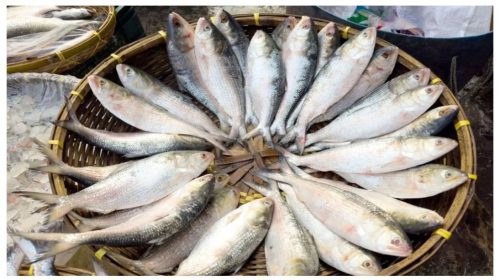
Bangladesh imported 352,787 kg of hilsa from India through Benapole in the first two months of the 2026–27 fiscal year, with imports rising sharply in August. Of this, 29,440 kg entered the country in July, the volume jumped to 323,346 kg in August—nearly eleven times higher than the previous month.
According to customs and Fisheries Quarantine Office data, the total declared value of the consignments was approximately Tk6.92 crore. Three importing companies brought in 29,440 kg of hilsa in July. The number of importers rose to 19 in August, when 323,346 kg entered the country. In total, 22 companies imported hilsa through Benapole during the two months.
There was a time when hilsa from Bangladesh was exported to India. But the importing of Indian hilsa into Bangladesh is a relatively recent phenomenon. Bangladesh’s domestic markets are increasingly receiving significant quantities of hilsa imported from India.
According to National Board of Revenue (NBR) data, imports of hilsa from India began in July 2025. Approximately 17,850 kg of hilsa was imported from India during that fiscal year. Imports then increased rapidly in 2026, with several hundred thousand kilograms entering Bangladesh within just the first few months of the current fiscal year.
According to traders, a significant portion of the hilsa coming from India is caught in western Indian areas, including Bharuch in Gujarat. These fish are sourced from rivers and estuarine areas connected to the Arabian Sea. Traders say there are differences in size and taste between these fish and hilsa from Bangladesh’s Padma-Meghna river basin.
Customs and business sources said hilsa is being imported from India through legal procedures using letters of credit (LCs). Importers pay the required duties and taxes before clearing the fish from the port. Ruhul Amin, acting director of Benapole Land Port, said the fish arriving in July and August were transported by Bangladeshi trucks to different parts of the country after completing customs clearance and other formalities.
Fisheries quarantine official Ashwadul Alam fo beanpole said quarantine certificates were issued only after the fish had undergone the required inspections. According to him, the hilsa entering through Benapole is Indian hilsa, and there is no information that hilsa from Myanmar is entering Bangladesh through Benapole. Myanmar’s hilsa generally enters the country through Chattogram Port.
According to customs and quarantine sources, the declared import price per kilogram varied among consignments and importers. Business sources said that in the case of one importing company, the declared import value was Tk252 per kilogram. After adding customs duties, taxes, truck transportation costs, LC expenses and other charges, the total cost comes to nearly Tk500 per kilogram.
Meanwhile, local traders said the same type of imported hilsa is being sold in Jashore, Benapole and other markets at Tk1,400 to Tk1,800 per kilogram.
This means there is a substantial gap between the import-stage price of the fish and its retail market price. Transportation, ice, storage, commission, wholesale and retail expenses, as well as business margins, contribute to this difference. However, the wide gap between import costs and retail prices has also raised questions among consumers.
BIGGEST ALLEGATION: INDIAN HILSHA SALES AS ‘Padma Hilsa’
More than the legality of importing hilsa, the identity of the fish in the marketplace has now become the bigger issue.
Several consumers and traders in different markets of southwestern districts allege that Indian hilsa is sometimes being sold as ‘Padma hilsa’, sometimes as ‘Chandpur hilsa’, and at other times as hilsa from ‘Barishal’ or ‘Chattogram’. As a result, ordinary consumers are being misled about the actual origin of the fish.
One reason such confusion can arise easily is the fish’s physical similarity. Imported hilsa looks very similar to Bangladeshi hilsa, making it difficult for ordinary consumers to determine its origin simply by looking at it. Several consumers said they noticed differences in taste and aroma only after cooking the fish.
On July 22, Benapole Customs seized approximately 360 kg of Indian hilsa from 12 cartons that had been declared as containing white fish. This indicates that, alongside legitimate imports through LCs, there have also been attempts to bring in hilsa under incorrect declarations. However, further investigation is required to determine whether this was an isolated incident or part of a broader pattern.
Several government offices including office of the National Consumer Rights Protection has said it is monitoring the issue.
Impact on the Domestic Hilsa Market
The biggest advantage of imported hilsa is its price. Traders said domestic hilsa weighing between 1.2 kg and 1.3 kg is currently selling for approximately Tk3,300 to Tk3,400 per kilogram in local markets. In contrast, imported hilsa of a similar size is available for Tk1,400 to Tk1,800 per kilogram.
This significant price difference is naturally encouraging some consumers to turn to imported fish. As a result, local hilsa traders have complained of declining sales.
REVERSAL IN THE HILSHA TRADE PATTERN
Bangladeshi hilsa once enjoyed a special position in the Indian market. Since 2019, the government had allowed specified quantities of hilsa to be exported to India every year ahead of Durga Puja. But the trade pattern has undergone a major shift since the last fiscal year.
Bangladesh exported approximately 125,000 kg of hilsa in the 2025–26 fiscal year, while importing approximately 10.62 lakh kg.
In the current fiscal year, Bangladesh has yet to export any hilsa. In contrast, approximately 591,000 kg has already been imported.
Meanwhile, Bangladesh has also been importing hilsa from Myanmar for many years.
According to NBR data for the past decade, Bangladesh has imported a total of approximately 30.62 lakh kg of hilsa from Myanmar since the 2019–20 fiscal year. In the latest fiscal year alone, nearly 10.25 lakh kg was imported.
Comment
Design & Developed by: BD IT HOST


 |
14 Septembertember, 2026
|
14 Septembertember, 2026