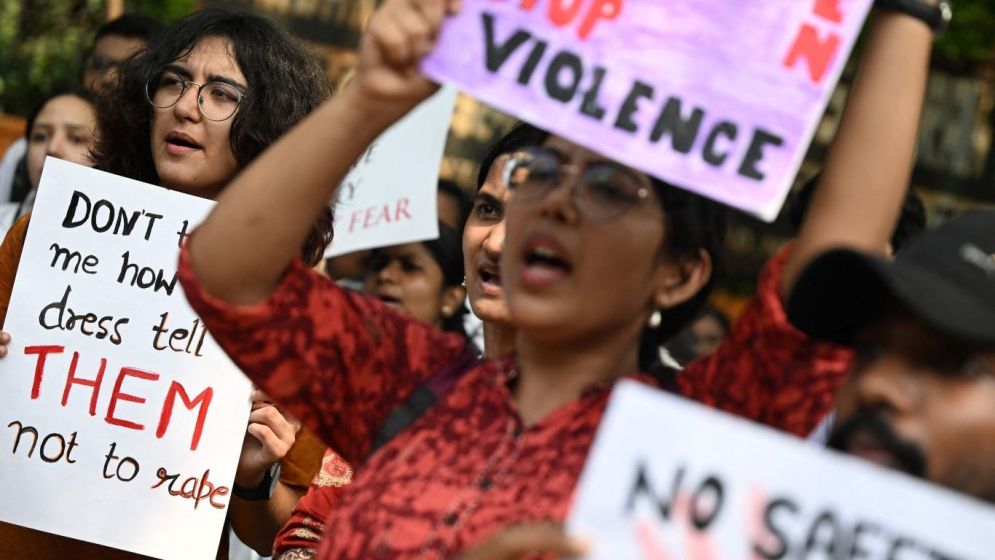
A string of rape cases in India has reignited debate over women’s safety and raised questions about why sweeping legal reforms and tougher punishments have failed to curb sexual violence.
Hundreds of students marched through the streets of New Delhi on Wednesday, shouting slogans and holding placards demanding stronger safety measures following the latest high-profile case.
In that incident on Monday, three men posing as police officers allegedly gang-raped a 17-year-old girl in a public park in the heart of the capital city, according to authorities.
The case evokes the 2012 gang rape and murder of a 23-year-old physical therapy student on a bus, which triggered nationwide protests and led to more robust laws against sexual violence.
But campaigners say those changes, which included a broadening of the definition of sexual offences and the introduction of stronger punishments for rape, have proven inadequate.
“Nobody is working on the actual solution, which is the mindset change,” women’s rights activist Yogita Bhayana told AFP.
“The mentality (is still) that it is a woman’s fault to be out of home late, or men policing women if they are seen with another man,” she said.
“It is outrageous that society still thinks this way.”
India recorded an average of 80 rape cases per day in 2024, according to the latest available official data. That compares with around 68 per day in 2012, the last year before the stronger laws came in.
Activists say the true number of sexual assaults is likely far higher because many victims never file a report, often fearing stigma in a deeply patriarchal society.
Lack of enforcement
The alleged assault on Monday followed the rape and murder of a 16-year-old girl whose body was found by police in a decomposed state, and the alleged rape of a 17-year-old girl by a bus driver and a conductor who offered her a lift during heavy rain.
Both cases occurred in recent weeks in Delhi — often called India’s “rape capital” — but other regions are not immune, with a video that surfaced this month showing a teenage girl being sexually assaulted in the eastern state of Bihar.
Each case has brought arrests, political condemnation and a public outcry.
After the watershed 2012 case — the woman is known nationally as “Nirbhaya” or “Fearless”, as Indian law does not allow the press to publish a rape victim’s name — the government expanded the criminal definitions of penetration and consent.
Gang rape became punishable by at least 20 years in prison, and the death sentence was introduced for repeat rape offenders.
Lawyers and activists say the challenge lies in enforcement.
Overstretched police forces and courts lack the means to investigate cases thoroughly enough, hindering the reforms’ impacts, criminal lawyer Shilpi Jain, who has represented survivors of sexual violence, told AFP.
“The problem is not in the law but with the people who are implementing it,” she said.
“Overworked judges. Overworked cops. One police station handles 200,000 to 300,000 people. How will it work? This is a vicious cycle.”
India’s conviction rate for rape has remained largely stable since 2012, hovering at around a quarter of all cases that make it to trial.
But the criminal justice system struggles with a vast case backlog.
Less than 10 percent of the more than 200,000 rape cases before the courts in 2024 were actually completed, according to official data.
“An average rape case takes seven to eight years. If the case goes to the Supreme Court, then 20 years, so criminals lose fear of law and victims lose hope,” Jain said.
For gender rights activist Poonam Muttreja, legal reforms alone cannot solve a problem rooted in social attitudes and inequality.
Deep-seated cultural taboos and political resistance have hampered the effectiveness of government programmes to raise awareness of sexual violence, experts say.
“Prevention must begin much before a crime is committed: in homes, schools, communities, digital spaces and police systems,” Muttreja said.
Comment
Design & Developed by: BD IT HOST


 |
25 Septembertember, 2026
|
25 Septembertember, 2026