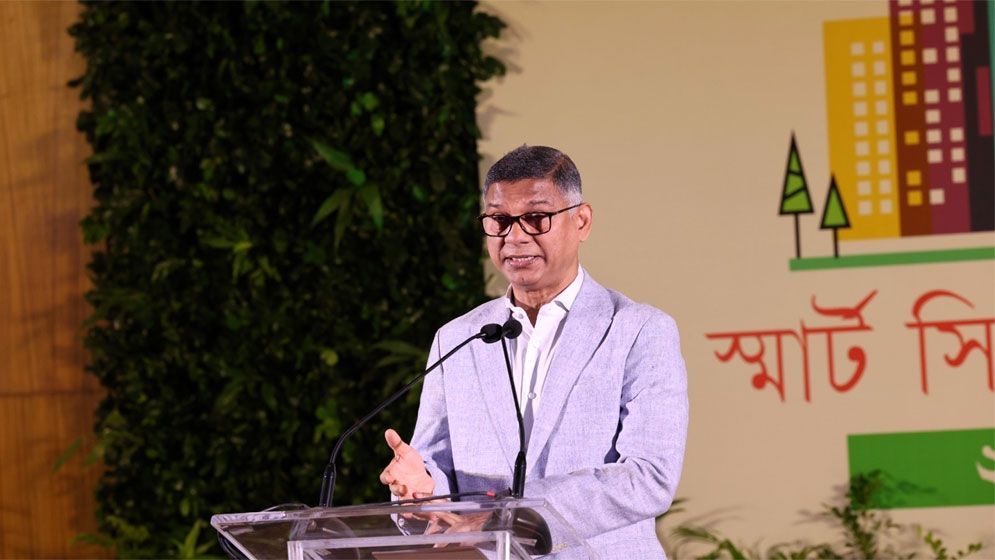
Affordable housing remains one of the biggest challenges to sustainable and smart urbanisation in Bangladesh, with Dhaka adding an estimated 2.5 lakh to 3 lakh units to its housing deficit every year, said Spacezero Ltd Managing Director Mohammad Foyez Ullah.
He made the remarks while addressing the Smart City Conclave at a hotel in the capital on Wednesday (7 October).
“Housing is a major structural challenge for smart cities and urbanisation. Housing is also Dhaka’s main crisis,” Foyez Ullah said, citing World Bank data.
He said ensuring adequate housing supply should come first, followed by proper financing and implementation, before efforts are made to make housing smarter.
Bangladesh must plan urban development within its limited resources and economic realities, he said, adding that the rapid urban development experiences of Japan, Seoul and Singapore could offer useful lessons.
“However, effective and realistic measures must be taken considering Bangladesh’s own circumstances,” he said.
Foyez Ullah stressed the need to make the housing sector environmentally sustainable, noting that residential buildings consume around one-third of the country’s total energy.
“Making the housing sector smart and green can lead to significant savings in energy consumption,” he said.
He also highlighted the importance of financing, saying mortgage financing in Bangladesh accounts for only 1.898% of GDP, compared with around 30% in China and more than 50% in Malaysia.
“Financing must therefore be given serious consideration to ensure sustainable urbanisation and housing,” he said.
Smart housing does not simply mean using advanced technology, solar roofs or various gadgets, he said. Rather, it should ensure natural light and ventilation, lower energy and water consumption and reduced long-term costs.
He suggested incorporating natural ventilation, proper building orientation, solar power, energy audits and water-saving measures into housing projects.
The location of housing is also crucial, he said, warning that an environmentally friendly building located far from workplaces and essential services could increase transport-related carbon emissions because of longer commutes.
“Transport costs, commuting and opportunities for walking must therefore also be considered in smart housing planning,” he said.
Foyez Ullah urged Rajdhani Unnayan Kartripakkha (RAJUK) and other development authorities, as well as relevant professionals, to prioritise natural light, ventilation and proper building orientation in building designs, saying such requirements could be made mandatory.
Noting that the Bangladesh National Building Code (BNBC), SREDA and other organisations already have policies and guidelines, he said the country had the necessary strategies and plans for environmentally friendly housing.
“The main challenges are implementation, large-scale application and financing,” he said.
Effective implementation of these measures would enable Bangladesh to make significant progress towards smart and sustainable housing, Foyez Ullah said.
Comment
Design & Developed by: BD IT HOST


 |
8 Octoberober, 2026
|
8 Octoberober, 2026