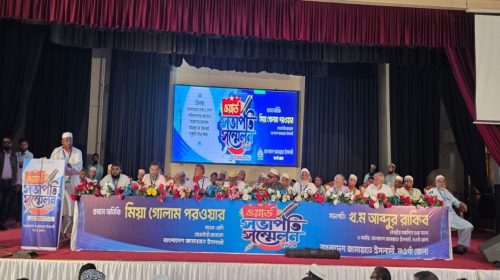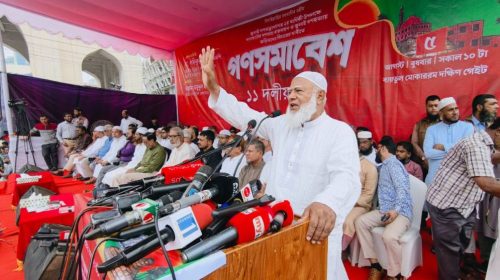
The Jamaat-e-Islami-led 11-party alliance has taken to the streets with a six-point programme that invokes some of the most pressing concerns of ordinary Bangladeshis: implementation of the referendum verdict, justice for those killed during the July uprising, an end to shortages of electricity, fuel, gas and fertiliser, action against rising prices, improvement of law and order, and an end to extortion, corruption and narrow partisan politics. The alliance began its Dhaka-Chattogram long march on Saturday.
There is no denying that these are serious issues. People are struggling with the cost of living, energy shortages and insecurity. The BNP government would be making a mistake if it dismissed these grievances merely because Jamaat and its allies are raising them.
But there is another question that deserves equal attention: is this really a movement to address people’s difficulties, or is it increasingly becoming a vehicle for political leverage and destabilisation?
The contradictions are difficult to overlook.
The first concerns the referendum and constitutional reform. Jamaat and the NCP are demanding implementation of the referendum verdict as though the referendum itself settles every question concerning the controversial reform package developed during the interim-government period.
It does not.
A popular mandate for reform must ultimately be translated into constitutional and legislative action through constitutionally recognised institutions. A referendum can confer political legitimacy; it cannot by itself eliminate parliament, legislative scrutiny or the constitutional process.
The BNP’s position has been considerably more nuanced than its critics suggest. Before the referendum, BNP spokesperson said the party would campaign for a “Yes” vote and that issues on which there were differences of opinion would subsequently be discussed in Parliament. The BNP had also objected to provisions envisaging a Constitution Reform Council, arguing that such a body had not been agreed upon and that Parliament—not an unelected or extra-constitutional mechanism—must have the final say in amending the Constitution.
That is a legitimate constitutional position, whether one agrees with it or not.
Yet Jamaat, NCP and Bangladesh Khelafat Majlis have chosen to boycott the special parliamentary committee established to work on constitutional amendments and declined to nominate members. The committee nevertheless began its work and has said it will review the entire constitution and seek views from constitutional experts, political parties and other stakeholders.
This produces an unavoidable question: if constitutional reform is genuinely the priority, why boycott the parliamentary forum where the reforms can be debated, amended and enacted?
The answer may lie in the politics of leverage. By staying outside the institutional process while demanding that the government implement its preferred interpretation of the referendum and reform, the alliance can keep the dispute on the streets rather than subjecting its proposals to parliamentary scrutiny.
That is not how constitutional democracy should work.
The rhetoric surrounding the agitation makes the concern more serious. The alliance has repeatedly warned of escalating its movement, while leaders have invoked the possibility of another mass uprising. Jamaat Secretary General Mia Golam Porwar has warned of public backlash if the programme is obstructed, while other alliance leaders have used increasingly confrontational language against the government.
Opposition parties have every right to march, protest and criticise the government. But there is a line between democratic pressure and political intimidation. A government elected through a constitutional process cannot be expected to surrender its authority every time a street mobilisation becomes sufficiently large.
The contradiction becomes particularly striking over fuel.
The alliance says it is protesting fuel shortages and the hardship caused by rising prices. Yet its own organisers initially planned a convoy of 5,000–6,000 vehicles. As an afterthought, citing fuel shortages and public inconvenience, they subsequently scaled the plan down to around 1,000 vehicles. By 4 September, however, Jamaat leaders said the number had risen again to nearly 1,500 vehicles.
This raises a perfectly legitimate question: who is financing such a massive mobilisation?
There is no suggestion here that the convoy itself proves financial wrongdoing. But thousands of vehicles travelling from Dhaka to Chattogram require fuel, drivers, logistics, food, publicity and organisational expenditure. A political alliance demanding transparency and accountability from the state should itself have no difficulty explaining how such a mobilisation is financed.
Transparency should not be a one-way street.
The alliance’s demands concerning energy, fertiliser and prices are, in fact, the strongest grounds for public pressure. But these problems require policy rather than spectacle. The government must ensure fuel availability, stabilise gas and electricity supplies, guarantee fertiliser distribution and take stronger action against hoarding, market manipulation and syndicates.
The BNP government should therefore not make the mistake of dismissing every criticism simply because Jamaat and NCP are making it. The grievances are real, and the government must respond to them with urgency.
But the opposition must practise the same accountability it demands.
The Anti-Corruption Commission has just opened an investigation into allegations involving former interim-government Youth and Sports Adviser and current NCP spokesperson Asif Mahmud Shojib Bhuyain and three ministry officials. The allegations concern irregularities in recruitment, transfers and promotions. The ACC has formed a four-member investigation team and has sought official records from the ministry.
The allegations should not be confused with guilt. Asif Mahmud is entitled to due process and has rejected the accusations. But the political point remains: no party can claim a monopoly on integrity while demanding that everyone else be scrutinised. If NCP claims to represent a new political culture, it should welcome the investigation, provide all relevant information and allow the ACC to complete its work independently.
Jamaat, meanwhile, has faced its own embarrassing test of moral accountability.
In July, Jamaat expelled Satkhira-4 MP Gazi Nazrul Islam after an internal investigation into allegations surrounding video footage involving him and a young woman. The party said its inquiry found evidence of “moral misconduct” and expelled him.
Nazrul disputed aspects of the controversy, saying the woman was his second wife. The Election Commission subsequently made clear that expulsion from a political party does not automatically vacate an MP’s parliamentary seat. The episode nevertheless raises an uncomfortable question for a party that presents itself as a guardian of Islamic morality and social values. Jamaat acted against its own lawmaker, which is preferable to ignoring the allegations. But the incident also demonstrates why no political organisation should claim an inherent moral superiority over its rivals.
Indeed, the controversy was serious enough to revive broader questions about standards of conduct for parliamentarians.
There have also been other allegations involving Jamaat activists, including the arrest of a party activist in Rajshahi in a case concerning alleged sexual harassment of a nine-year-old girl. The allegation must be decided through due legal process, and it would be wrong to generalise from an individual case to an entire party. But a party that places morality at the centre of its political identity must understand that its own members’ conduct will inevitably be scrutinised against the standards it claims to uphold.
The same principle applies to misinformation.
Bangladesh’s political discourse has become increasingly polluted by fabricated claims, manipulated videos and partisan disinformation. No party has clean hands in this regard. But parties claiming to represent a new political order should be particularly careful not to turn social media propaganda into a substitute for evidence and argument.
And then there is history.
Jamaat cannot reasonably expect the country to discuss its present political ambitions without remembering its deeply controversial role during the 1971 Liberation War. Political participation and political rehabilitation are part of democracy. But rehabilitation cannot mean historical amnesia. A party seeking national leadership must demonstrate that it fully accepts Bangladesh’s pluralist democratic identity and the historical foundations of the state.
The government, too, has responsibilities.
It must urgently address fuel and gas shortages, electricity disruptions, price pressures and law-and-order concerns. It should publish clear action plans, strengthen market monitoring, investigate allegations of corruption impartially and communicate more effectively with citizens. It should also ensure that peaceful opposition programmes are allowed to proceed while preventing violence, intimidation and disruption of public life.
But Jamaat and NCP must decide what kind of opposition they want to be.
They can become a constructive parliamentary opposition: scrutinising legislation, proposing alternatives, exposing government failures and mobilising public opinion peacefully.
Or they can continue to treat every disagreement as grounds for another street confrontation and every institutional disagreement as justification for threats of another “uprising”.
Bangladesh has already paid a terrible price for politics conducted through confrontation.
The opposition should therefore stop the politics of deflection and prove its claim to public confidence through democratic participation. If its interpretation of the referendum has popular support, let it defend that interpretation in Parliament. If the government is failing on energy, prices or law and order, let it present detailed alternatives. If it demands accountability from ministers and officials, let its own leaders accept the same scrutiny.
Above all, political leaders should stop using language that threatens the stability of an elected government. The memory of past political violence should be a warning, not an invitation.
A referendum does not abolish Parliament. An election does not give a government unlimited power. And an opposition cannot scheme to secure victory at the next election by manufacturing instability today.
The road to power in a democracy runs through the people, the ballot box and Parliament—not through threats of another violent uprising.
The BNP government must govern better. The opposition must oppose responsibly.
That is the democratic bargain.
Bangladesh needs functioning institutions, accountable government and a credible opposition—not another contest over who can create the greatest political crisis.
The long march may command headlines. But the real test of Jamaat-e-Islami and NCP will come when the cameras disappear and Parliament resumes its work.
If they truly believe in reform, they should come inside the institutions of the republic and fight for it there.
Comment
Design & Developed by: BD IT HOST


 |
5 Septembertember, 2026
|
5 Septembertember, 2026