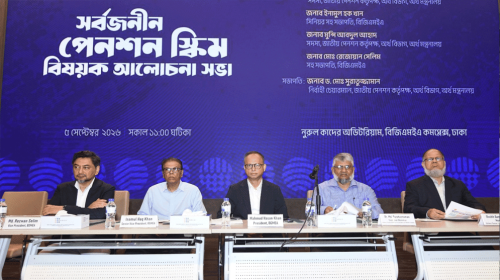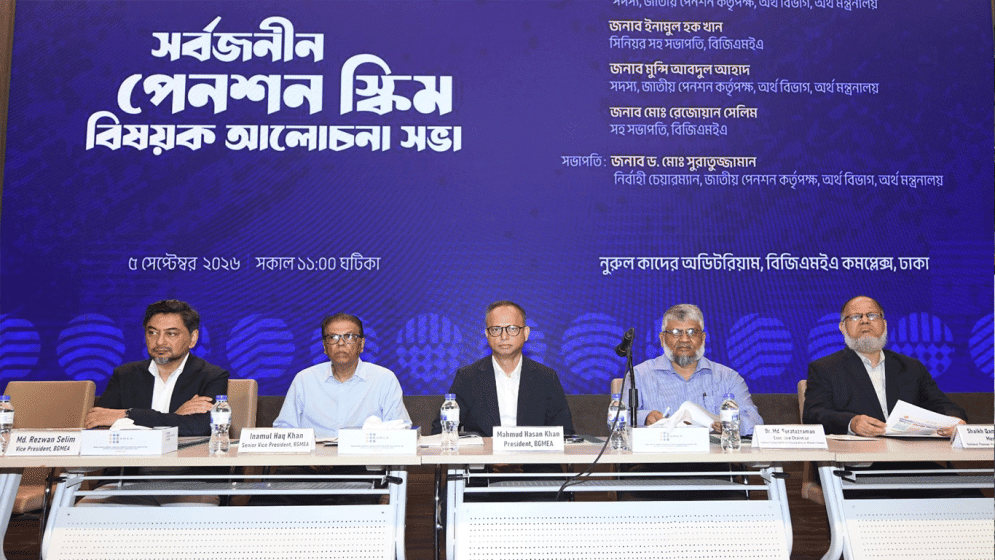
A discussion meeting on the Universal Pension Scheme (UPS) was held on Saturday with the participation of members of the Bangladesh Garment Manufacturers and Exporters Association (BGMEA) and stakeholders of the apparel sector.
The meeting was organised at the Nurul Quader Auditorium of the BGMEA Complex in the capital, said a press release.
BGMEA President Mahmud Hasan Khan attended the meeting as the chief guest, while member of the National Pension Authority (NPA) under the Finance Division of the Ministry of Finance Sheikh Kamrul Hasan, BGMEA Senior Vice President Enamul Haque Khan and Vice President Md Rejwan Selim spoke as special guests.
NPA Executive Chairman Dr Md Suratujjaman chaired the meeting.
In his welcome address, Sheikh Kamrul Hasan said the government introduced the Universal Pension Scheme to ensure financial and social security for people in old age, considering the country’s social and economic circumstances.
Presenting the keynote paper, NPA Executive Chairman Dr Md Suratujjaman said the government introduced the universal pension system to ensure the future financial security of the people, which would become a major source of financial protection for citizens in their old age.
He said citizens aged between 18 and 50 can contribute to the scheme through banks and will receive their accumulated contributions as pension after attaining the age of 60.
“If a subscriber dies before reaching 60, the nominee will receive the deposited amount along with profits,” he said, adding that subscribers facing income-related difficulties would have the flexibility to increase or decrease their contribution.
He said the money deposited under the scheme would be returned to the subscribers in due course, helping ensure a better standard of living after the age of 60.
Dr Suratujjaman said the government has already decided to invest around USD$100 million with financing from the Asian Development Bank (ADB) to make the pension scheme more dynamic and stronger.
He also pointed out that the latest amendment to the Bangladesh Labour Act 2026 makes it mandatory for workers of industrial establishments employing more than 100 workers to be brought under the Universal Pension Scheme.
The NPA executive chairman urged such industrial establishments to take initiatives to open accounts under the universal pension scheme for their employees.
Calling upon BGMEA to play a leading role in bringing entrepreneurs and workers of the apparel industry under the scheme, he said initiatives should be taken to bring at least one member from every family under the universal pension system.
The government, recognising the importance of the Universal Pension Scheme, had included the formation of a pension fund in its 2026 election manifesto and was working towards its implementation, Dr Suratujjaman added.
Speaking as the chief guest, BGMEA President Mahmud Hasan Khan said the government is fully committed to ensuring the overall welfare as well as social and financial security of the people.
“An initiative should be taken to include all apparel sector workers in the Universal Pension Scheme as soon as possible,” he said, adding that it would play a historic role in implementing the government’s electoral pledge and establishing a discrimination-free Bangladesh.
To make the scheme more popular and attractive among workers, he proposed providing special government incentives during the first two years and reducing the pension age for garment workers from 60 to 55 years.
“If these reforms are implemented, workers will be more interested in joining the scheme voluntarily,” he said.
BGMEA Senior Vice President Enamul Haque Khan said bringing around five million workers of the ready-made garment sector under the Universal Pension Scheme and maintaining its management on a continuous basis would be somewhat challenging.
“Despite the challenges, the government’s initiative to introduce the scheme is very timely, groundbreaking and commendable,” he said.
BGMEA Vice President Md Rejwan Selim said the attractive rate of return under the Universal Pension Scheme could play a unique role in ensuring long-term protection for garment workers.
“Therefore, BGMEA will work with a specific plan to bring all workers in the apparel sector under this groundbreaking scheme,” he added.
During the meeting, participants raised various questions and concerns regarding the scheme. The NPA executive chairman responded to their queries with detailed explanations and reassured them.
The speakers said the government had undertaken the programme to bring people from all sections of society under an organised social security framework, while the participation of a large employment-generating sector like the apparel industry would be particularly important.
BGMEA members, garment factory owners, officials, workers’ representatives and other relevant stakeholders attended the meeting.
Comment
Design & Developed by: BD IT HOST


 |
5 Septembertember, 2026
|
5 Septembertember, 2026