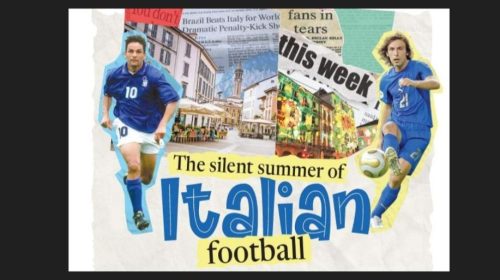
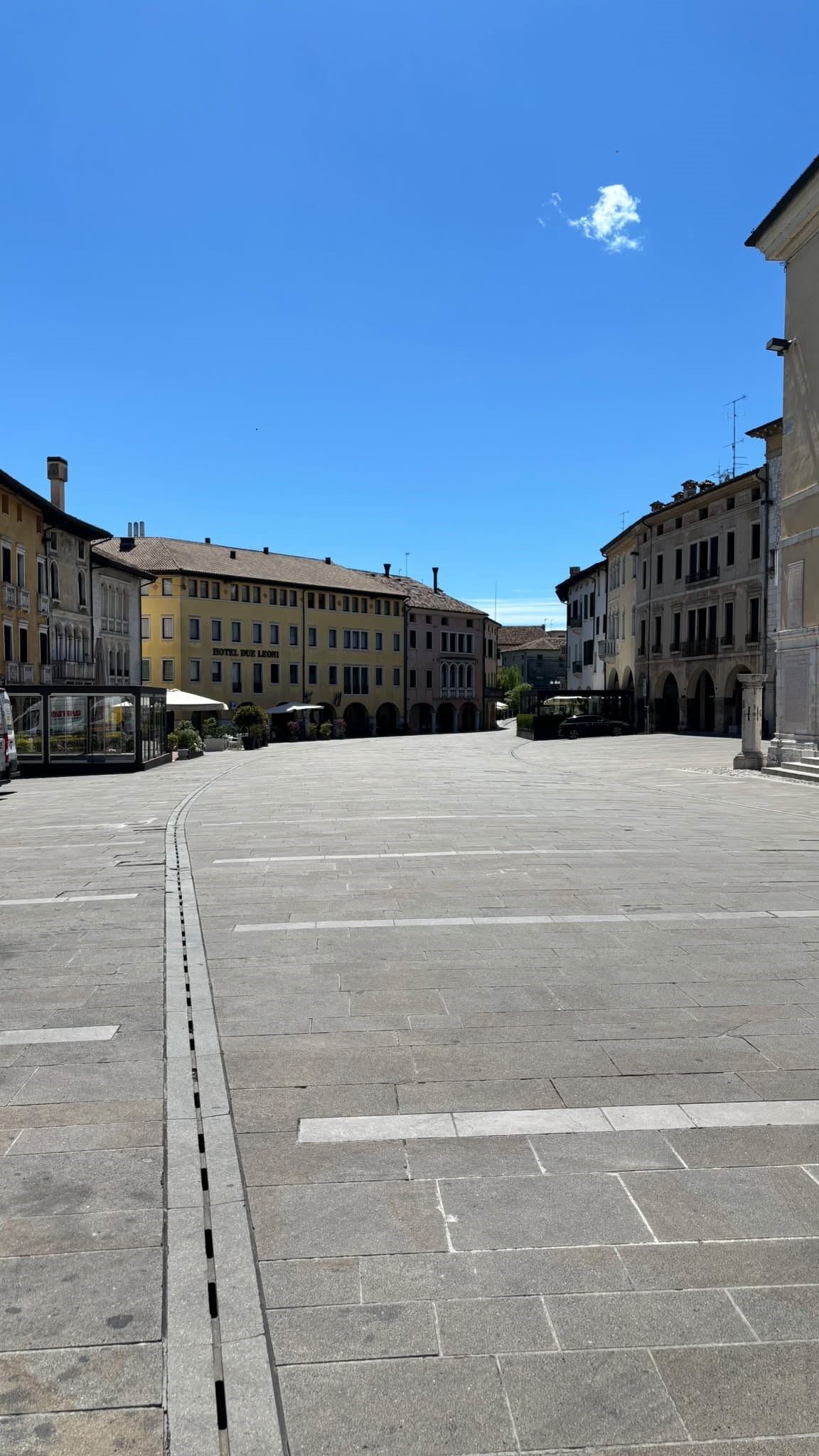
Walk through any city in Veneto or Friuli of Italy right now. I mean it. Try Treviso. Try Pordenone – that’s where I live. Try Padua. Take the long way, the little streets behind the old church, past the bar where the men stand at the counter with their morning espresso and a newspaper folded under one arm. Then stop. Look up at the balconies. Nothing. No flags. No blue and white bunting. No handwritten banners that some kid made with a marker and too much tape to show support for his footballing heroes at the World Cup. Just bare. I’ve been looking at them for weeks now. The balconies of Treviso, of Pordenone, of Padua are all bare.
I keep looking because I think maybe today someone will hang something. But no.
If you arrived here knowing nothing about football calendars or qualifying campaigns, you would have no idea that the biggest tournament on earth starts in a matter of days. Really. No signs.
This is the new Italy. Not the one I saw in 2006. Not the one that filled every piazza with noise and colour and that particular kind of delirium that only happens when a whole country decides to lose its mind together.
This one is quieter. Resigned, maybe. A country that has missed the World Cup for the third time in a row: 2018, 2022, and now 2026. And people here have started, slowly and almost without noticing, to make their peace with it.
I arrived in Italy in November 2005. I remember the cold. I remember not understanding a word. Eight months later on 9 July, 2006, I was in Piazza XX Settembre in Pordenone with my nephews. Big outdoor screen. Italy against France. The match went to penalties.
I remember very little of what happened right after Fabio Grosso kicked that ball. What I remember is the feeling that a bomb had gone off. Not a real bomb. A bomb made of pure, stupid, human energy. The square didn’t cheer. It exploded. People I had never seen before were hugging me. Someone was crying. Someone else, I swear, was already climbing a lamppost. Yes, a lamppost. Like that was a normal thing to do.
For that one night, the city had suspended the normal rules. It was one of the most alive I have ever felt anywhere. The next morning I had to go to work.
In Bangladesh, where I’m from, a victory like that, if Bangladesh had ever been able to win something like that, would have meant three days of official national holiday. The streets would have been blocked for a week.
Italians, in their complicated relationship with collective joy, always go back to normal pretty fast. The party is intense, and then it’s over. That’s also part of the Italian character, I’ve learned.
What strikes me now? Twenty years later, can you believe it? It is not the noise of 2006. It’s the silence of 2026. Last week I went to my usual bar near home. The man behind the counter, his name is Davide, I think, though I’ve never actually asked, I’ve been buying coffee from him for years.
I asked him if he was planning to watch the World Cup. He made this gesture that I’ve come to recognise as very Italian. A slight tilt of the head. A small movement of the hand. An expression that contains an entire philosophy of resigned acceptance.
“Some matches, yes,” he said. “But without Italy, it’s different. You watch as a stranger.” As a stranger. He said it without anger. Without any particular sadness.
The way you might describe the weather. And that, I don’t know how, hit me.
Three consecutive absences. That’s what they’ve done to Italian football culture. Not shattering it completely but shifting it. Like a piece of furniture someone moved two centimeters and now you keep bumping into it. The passion for the game is still there. Serie A gets followed with devotion, sometimes with fury. Club loyalties run deep and deeper than I’ll ever understand, honestly. But the national team? The one that used to dissolve all internal divisions, from the historical north v south, to Juventus v Inter, Milan, Roma, Napoli, all of it, that team has quietly withdrawn from the center of Italian emotional life.
I talked to a teacher in Mestre. Secondary school. She told me that her students barely register the absence. “For them,” she said, “the World Cup is Argentina and France and Brazil. Italy is their fathers’ team.”

They follow clubs, they follow individual players. The national team is somewhere else in their imagination. A generation is growing up here that has never experienced a World Cup night like 2006.
The last time Italy made it past the group stage, let me do the math, the oldest of these students were in primary school.
Over the last few days I’ve been paying attention to the small signs. Yesterday I went to Bologna for a seminar. Before the train, I walked through Mestre. Later I spent hours in the center of Bologna. Today I walked again through Pordenone.
No Italian flags on balconies. The few football shirts I saw and I looked; they weren’t Italian either. Mostly Argentina. That light blue and white.
The conversations were maybe even more telling. In bars and cafes, it was often immigrants, Italians seemed more detached.
They’ll still watch, sure. But often as neutrals. And here’s the thing: when the tournament starts, many Italians will probably end up supporting Argentina or Brazil. That’s not an accident. Both countries are deeply connected to Italy through migration.
Argentina especially, they are one of the largest populations of Italian descent in the world. In the absence of the Azzurri, many Italians might cheer for nations that still feel, in some distant way, like distant cousins.
I’ve been trying to understand this detachment for weeks. I think I’ve arrived at something close to an answer. Passion for football, the real kind, isn’t built only from success. It’s built for me, mostly from imagination. The willingness to believe that something larger than yourself is at stake.

That the result of a match can contain something essential about who you are and where you come from.
Italy is losing it. Slowly. Precisely because the results have denied it the occasions to practice it.
The bars will still show the matches. The newspapers will write analyses. Italy will go about its summer with its beaches, the long lunches, the particular beauty of an Italian evening in June and the World Cup will pass around it like weather passing through a town that has closed its windows.
Maybe it’ll change. Maybe a young player will emerge, a new cycle will begin, and in four years Italy will be back, and the flags will reappear on the balconies of Treviso and Pordenone and Mestre.
Italians are resilient. And football here is too old and too loved to disappear. But I keep thinking about Piazza XX Settembre in the early hours of 10 July, 2006. What it felt like to be inside something that large, that shared. And then about Davide at the bar, watching as a stranger. And about those kids in Mestre who don’t even know they’re supposed to miss something. Maybe that’s the real silence.
Comment
Design & Developed by: BD IT HOST


 |
12 June, 2026
|
12 June, 2026