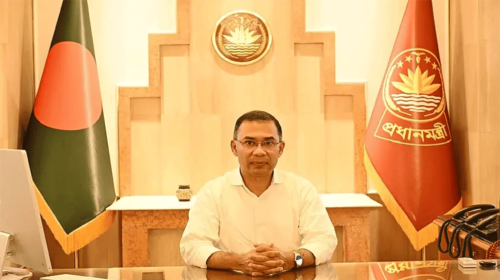
The government is facing a difficult situation due to long-standing irregularities and structural weaknesses in the power sector, said Energy and Mineral Resources Minister Iqbal Hassan Mahmood on Friday.
Speaking at a post-budget press briefing at the Osmani Memorial Auditorium in Dhaka, the minister said the current administration has inherited what he described as a “legacy of mismanagement” in electricity generation, procurement, and project execution.
He pointed to capacity charge agreements with private power producers, flawed contracts, and weak oversight as key factors behind the sector’s financial strain. According to him, many of these agreements were structured in a way that heavily protected investors while limiting government flexibility.
The minister said negotiations with power producers, including foreign investors, have so far yielded limited progress, as many contracts legally bind the state to capacity payments. Terminating such arrangements abruptly, he warned, could trigger legal disputes and even risk power shortages.
He also highlighted that delays in maintenance and underutilisation of state-owned power plants have increased reliance on private generation, contributing to an outstanding liability of around Tk56,000 crore.
Among examples of irregularities, he cited large-scale procurement of digital meters under the Rural Electrification Board that remained largely unused for years, as well as delayed execution of major infrastructure projects under the Dhaka Power Distribution Company, including underground cabling and substation development.
The minister said some ongoing projects are partially complete, but cancelling them now would risk wasting significant public funds already spent.
He added that the government is reviewing capacity charge issues with legal authorities, and any further action will depend on their opinion.
Despite these challenges, the government is also pushing reforms in the sector, including a shift toward renewable energy. The minister said plans are underway to generate 5,000 megawatts of solar power by 2030, alongside incentives for battery-based solar systems in the upcoming budget.
According to him, global energy market volatility, including disruptions in Middle Eastern supply chains, has further complicated the situation, forcing Bangladesh to secure alternative fuel sources to maintain stability.
The minister said the government, which assumed office only a few months ago, is now working to stabilise the sector and expects visible improvements within the next two to three years.
Comment
Design & Developed by: BD IT HOST


 |
12 June, 2026
|
12 June, 2026