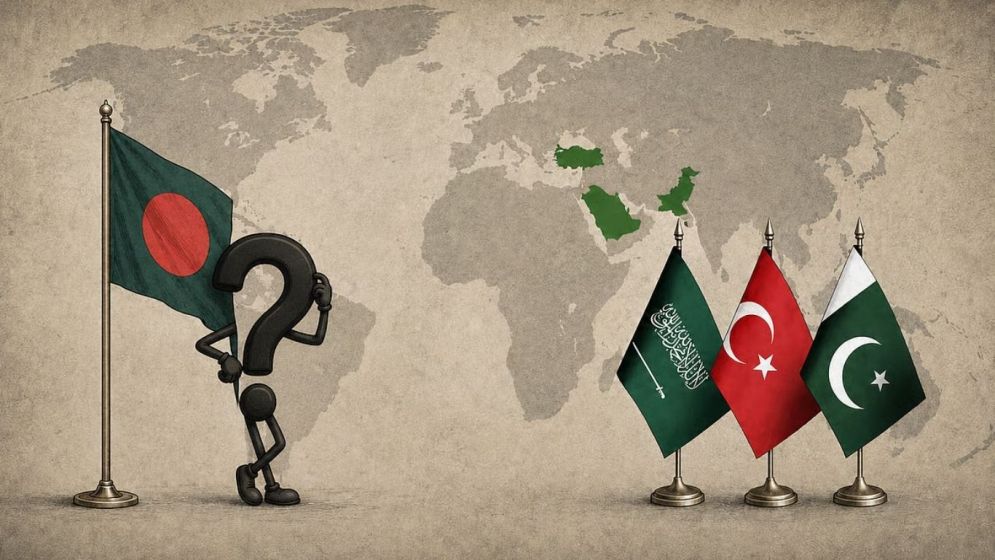
The debate over whether Bangladesh should join the proposed “Mecca Joint Defence Pact” has so far focused largely on the diplomatic implications. But there is another important dimension that deserves attention: the military one.
If Bangladesh eventually joins the arrangement, it needs to be clear what responsibilities and expectations could be placed on its armed forces.
Saudi Arabia, Türkiye and Pakistan signed the Mecca Joint Defence Pact on August 7. Based on information made public so far, one of its key principles is that an armed attack on any one of the three countries would be treated as an attack on all. The pact also calls for stronger defence cooperation among the members.
The first meeting of the arrangement’s strategic political and defence committee was held in Istanbul on August 31.
Bangladesh has said it would consider the matter positively if invited. Dhaka, however, has not yet received any formal proposal. So, at this stage, there is no basis to say that Bangladesh has incurred any military obligation.
Instead, before taking any decision, it is important to understand the pact’s military and legal implications. One point deserves particular attention: Bangladesh has traditionally not sent its armed forces to fight wars in other countries. Its military has, however, played a major role in UN peacekeeping operations.
Cooperation is not the same as collective defence
Bangladesh already maintains military cooperation with a number of countries through training, exercises and professional exchanges.
It also has a long record of participation in UN peacekeeping missions. But a collective defence arrangement is fundamentally different from conventional defence cooperation.
If one member of such an arrangement comes under attack, other members could be expected to provide assistance. That assistance could take many forms, including intelligence, logistics, medical support, training, or naval and air capabilities. Depending on the circumstances, however, the question of deploying military personnel could also arise.
That makes one issue particularly important for Bangladesh: what exactly would it be required to do?
Would Bangladesh be obliged to send troops to fight in another country’s conflict? If so, who would make that decision? These questions should be clearly settled before Bangladesh makes any commitment.
The realities of military capability
The primary responsibility of Bangladesh’s armed forces is to defend the country.
Beyond protecting its territory, airspace and maritime interests, the military has a range of other responsibilities. How many troops Bangladesh could realistically deploy abroad would depend on factors such as the readiness of its units, training, rotation requirements, reserves, transportation, logistics and medical support.
Any new military commitment should therefore be preceded by a professional assessment of the armed forces’ actual capacity.
Command and control
One of the most important questions would be who commands Bangladeshi forces in any joint operation.
Could a multinational commander order Bangladeshi troops into combat without obtaining separate approval from Bangladesh? Would Dhaka be able to impose national conditions on the use of its forces?
These matters should be explicitly addressed in writing.
There is another question that needs equal attention: if Bangladesh itself came under attack and forces from other member states were deployed here, what would their legal and military status be?
Pakistan’s position as a founding member of the pact makes this issue particularly sensitive for Bangladesh, given the historical and political context of the two countries.
The constitutional question
Bangladesh’s Constitution also needs to be taken into account.
Article 63(1) states that Parliament’s assent is required before war can be declared or the Republic can participate in any war.
How this provision would apply to a collective defence pact needs to be examined carefully from a legal perspective. If Bangladesh were drawn into a conflict under such an arrangement, how and when would parliamentary approval be required?
These questions should be answered before Bangladesh signs up to any collective defence commitment.
There are alternatives to joining
Bangladesh does not necessarily have to choose between joining the pact and staying completely outside the arrangement.
It could instead deepen bilateral defence cooperation with Saudi Arabia, Türkiye and Pakistan through military education, training, joint exercises, maritime security, intelligence sharing and defence technology.
Türkiye offers potential opportunities in defence technology and the defence industry. Pakistan can provide military-to-military experience and professional exchanges, while closer ties with Saudi Arabia could have broader financial and strategic benefits.
But these opportunities should not be conflated with the potential obligations that could come with joining a collective defence arrangement.
Ultimately, the question is bigger than whether Bangladesh should join the pact.
Before making such a decision, Dhaka needs to establish how much the arrangement would actually strengthen Bangladesh’s security—and what military obligations it could create in return.
The first duty of Bangladesh’s armed forces is to defend Bangladesh. Any decision to join a collective defence arrangement should therefore ensure that the authority to decide when, where and under what circumstances Bangladeshi troops will serve remains firmly in Bangladeshi hands, subject to the country’s constitutional requirements.
Comment
Design & Developed by: BD IT HOST


 |
2 Septembertember, 2026
|
2 Septembertember, 2026