Policy and business leaders on Sunday said unreliable gas and electricity supply is directly undermining industrial competitiveness, with low gas pressure, production disruptions and costly alternative fuels placing growing pressure on exporters.
They called for priority energy allocation to export-oriented industries and major industrial clusters, alongside advance and credible load-shedding schedules to help factories plan production.
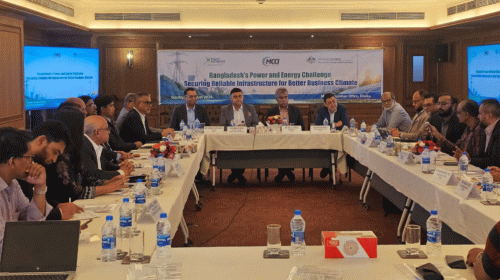
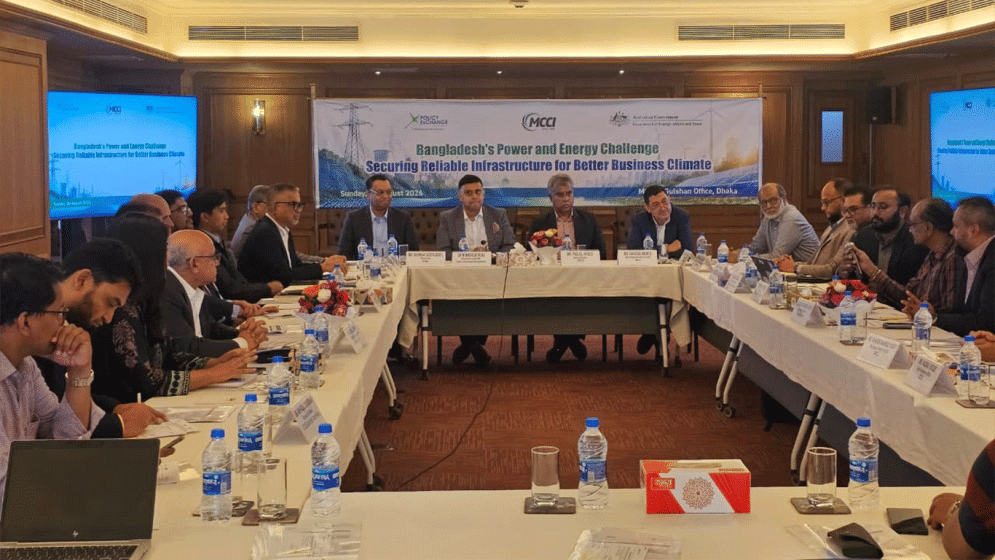
They made the call at a roundtable titled “Bangladesh’s Power and Energy Challenge: Securing Reliable Infrastructure for Better Business Climate” organised by Policy Exchange Bangladesh and the Metropolitan Chamber of Commerce and Industry, Dhaka (MCCI), with support from the Australian Government Department of Foreign Affairs and Trade, at the MCCI Conference Hall in Gulshan.
The discussion drew on findings from the Bangladesh Business Index (BBX) 2024–25, which showed that the Business Infrastructure score declined from 71.1 in 2023–24 to 68.8 in 2024–25. The findings point to energy reliability as a major concern for businesses: 74.2% of respondents reported experiencing power outages sometimes, while only 20.1% observed structural or regulatory efforts to improve infrastructure.
Pharmaceuticals and chemicals, as well as electronics and light engineering, were among the sectors reporting particularly high exposure to recurring outages.
The dialogue took place against the backdrop of persistent gas shortages, inadequate gas pressure, fuel constraints, rising energy costs and supply interruptions that continue to affect industrial production, business operations and investment planning. In early August 2026, the country’s power shortfall exceeded 3,000 MW, while low gas pressure forced many factories to reduce or suspend production.
The session began with welcome remarks by Farooq Ahmed, secretary-general and CEO of MCCI. This was followed by a trigger presentation titled “Business Infrastructure – Power and Energy” by Hassib Hasan, Senior Associate, Policy Exchange Bangladesh, presenting BBX findings on power and energy reliability, sectoral exposure and regional patterns.
A moderated panel discussion led by Dr M Masrur Reaz, chairman and CEO of Policy Exchange Bangladesh, brought together Showkat Aziz Russell, president of Bangladesh Textile Mills Association (BTMA); Mohammad Iqbal Chowdhury, director and chief executive officer, LafargeHolcim; Dr Ijaz Hossain, chairman, ESTex Foundation; and Moynul Islam, president, Bangladesh Ceramic Manufacturers & Exporters.
Mohammad Iqbal Chowdhury stressed the need to protect existing industrial investments through a credible and predictable long-term energy outlook. He called for a clear 10–20 year energy strategy focused on competitiveness and sustainability.
Moynul Islam highlighted that gas is a critical production input for the ceramic industry, not merely an energy source. He warned that prolonged supply uncertainty threatens production, employment and investment.
Dr Ijaz Hossain noted that the energy crisis is now an economic and planning challenge, not only a supply problem. He called for better pricing, fuel allocation, renewable energy, efficiency and a more realistic energy mix.
Showkat Aziz Russell said current shortages reflect weaknesses in long-term planning and fuel procurement. He called for an industrial energy policy and immediate measures to protect energy-intensive and export-oriented industries.
Fazlul Houqe, administrator of the Federation of Bangladesh Chambers of Commerce and Industry (FBCCI), delivered remarks as the guest of honour, while Kamran T Rahman, president of MCCI, delivered the closing remarks.
The dialogue concluded with a shared call for a prioritised, evidence-based and action-oriented energy reform agenda that protects existing investment while creating the confidence required for future industrial expansion.
Recommendations emerging from the roundtable will inform a policy note linking BBX evidence with immediate and structural reforms, including measures to strengthen fuel security, improve supply reliability, promote predictable pricing, accelerate domestic exploration and renewable-energy deployment, and strengthen public-private coordination.
Comment
Design & Developed by: BD IT HOST


 |
1 Septembertember, 2026
|
1 Septembertember, 2026