Labour rights experts on Sunday called on the authorities concerned to ensure a transparent, predictable and time-bound trade union registration process in line with the Bangladesh Labour Act, 2006, warning that delays in accepting applications and additional administrative requirements may create practical barriers to workers’ freedom of association.
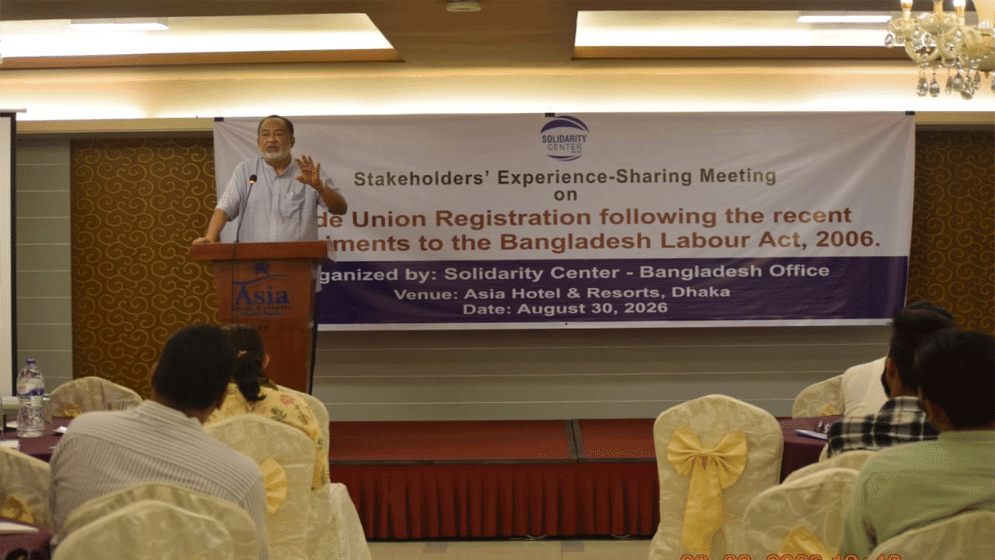
The call came at a stakeholders’ experience-sharing meeting titled Trade Union Registration following the recent Amendments to the Bangladesh Labour Act, 2006, organised by Solidarity Center at a hotel in Dhaka.
Solidarity Center Country Programme Director AKM Nasim presented the keynote at the event. The paper examined several registration cases and found delays between the first submission of applications and their formal acceptance.
A key concern was the Department of Labour’s apparent practice of requiring employer certification of the total number of workers as a mandatory document for every application. The paper noted that Section 178(5) of the Labour Act provides a mechanism for obtaining such information from management but does not make employer certification a mandatory attachment to every application.
The paper read the DoL can verify workforce information through workers’ registers that employers are already required to maintain under the Labour Act and Labour Rules. It recommended that employer certification should not be treated as a precondition for accepting an application.
It also mentioned concerns about the statutory registration deadlines. Under Section 182, objections to a materially deficient application should be communicated within 12 days of receipt, while registration should be completed within 55 days. The paper warned that delaying formal acceptance of applications can effectively postpone these statutory deadlines.
The experience of Libas Knitwear Ltd. Sramik Union was cited as an example. The union submitted its application on 25 November 2025, but the Department did not formally accept it until 27 February 2026—a gap of about 95 days. The application had initially been returned because management certification on the number of workers was not submitted.
Another case involved Garment Workers’ Solidarity Federation Affiliated Texas Dresses Sramik Sanhati Union. Its application was submitted on 13 January 2026, and was eventually rejected on 21 April. The paper noted that the decision came 59 days after the disputed date of acceptance, exceeding the statutory 55-day period.
The paper also raised concerns about the online registration system. It recommended that every application receive an acknowledgement showing the date and time of submission and that this original submission date be treated as the official date of receipt.
AKM Nasim said, “The amended labour law was intended to simplify trade union registration, but unions are still facing new procedural and practical barriers at various stages. These challenges must be identified and addressed through dialogue with stakeholders to ensure the law facilitates, rather than obstructs, workers’ right to freedom of association.”
The speakers called for a clear and uniform registration procedure. They recommended distinguishing statutory requirements from documents sought only for verification and ensuring that all objections and decisions are communicated within the time limits set by law.
Rashadul Alam Raju, general secretary of Bangladesh Independent Garment Workers’ Union Federation, said, “The authorities introduced online submission to ease the union registration process. But in reality, the applications remain pending in the server for months. It has become a new hassle.”
Echoing the same, Nahidul Hasan Nayan, general secretary of the Sommilito Sramik Federation, said, “It appears that the ILO, with a good intention, has been providing technical assistance to improve the online trade union registration process.”
“However, this assistance has been ongoing for quite some time. The ILO should ensure that its technical assistance and investment ultimately result in a functional, transparent and effective system. We do not want to see another flawed system being put in place despite the technical assistance and resources provided by the ILO,” he added.
Nazma Akter, president of Sommilito Garment Sramik Federation, said, “The problem of trade union registration is contributing to deteriorating industrial relations. It affects not only workers but also good governance, while raising questions about the transparency and goodwill of the authorities.”
Bangladesh Revolutionary Garment Workers Federation President Salauddin Shapon, President of Bangladesh Garment and Industrial Workers Federation Babul Akter, Socialist Workers’ Front General Secretary Ahsan Habib Bulbul, and Bangladesh Garment Workers Solidarity President Taslima Akter spoke among others in the event.
Comment
Design & Developed by: BD IT HOST


 |
30 Augustust, 2026
|
30 Augustust, 2026