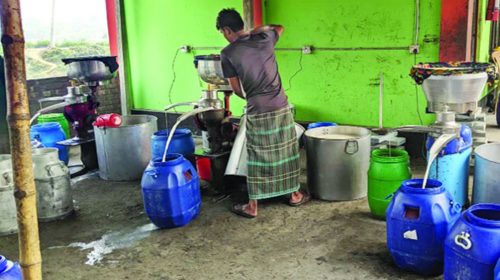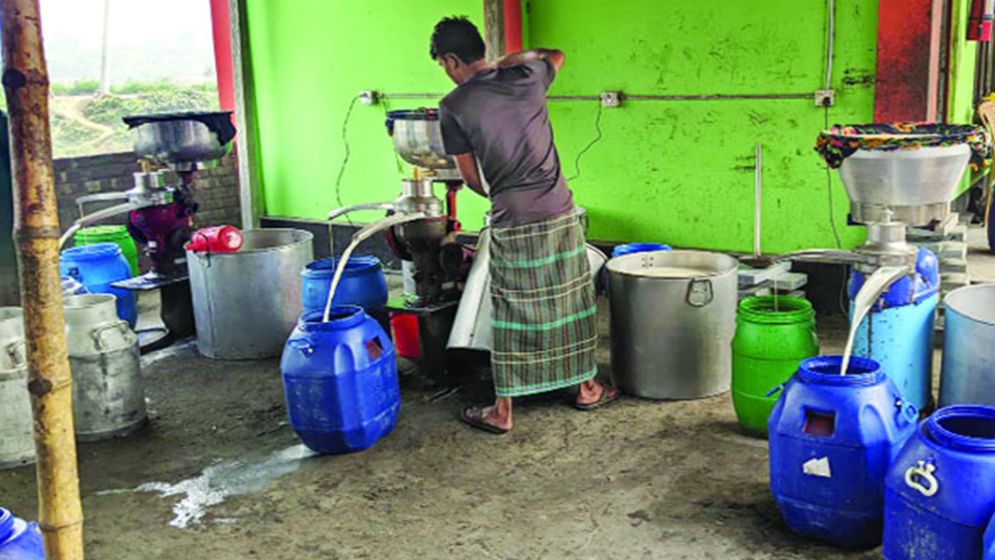
Fake dairy farms have mushroomed across Pabna district, with farms operating in neighbourhoods and even inside homes. But many of these businesses reportedly have no cows, yet regularly supply large quantities of milk to chilling centres operated by reputed dairy companies.
Investigations have found allegations that some unscrupulous traders are producing adulterated milk using soybean oil, glucose, saccharin, urea fertiliser, detergent powder, caustic soda and other chemicals. The artificial liquid, made to resemble milk in colour, consistency and fat content, is then supplied to chilling centres, unauthorised milk collectors and local markets.
Some traders reportedly purchase milk from the market, separate the curd or cream and then mix chemicals with the remaining white liquid instead of discarding it, producing what they sell as milk.
More than 200 chilling centres—facilities used for quality testing and preliminary storage—have reportedly been established in Bhangura, Chatmohar and Faridpur upazilas, either under recognised brands or private ownership. Of these, 92 are operated by various reputed companies, while the rest are privately owned.
There are also numerous chilling centres in Santhia, Baghabari and Bera. The wider Baghabari area is a major hub for milk production, collection and marketing in the country.
Factories allegedly producing adulterated milk have been operating openly and secretly for years in more than 50 villages across Bera, Santhia, Bhangura and Faridpur. Their activities reportedly take place from early morning until 9am and again from evening until around 10pm.
The adulterated liquid is reportedly made to look like genuine cow’s milk, with a bright white colour, desired consistency and apparently acceptable fat content. It is then sold through chilling centres of reputed dairy companies, unauthorised milk suppliers and local markets.
Although the authorities periodically conduct drives and fine those involved, people familiar with the trade said the penalties are insignificant compared with the profits generated by the illegal business.
According to several traders involved in the adulteration racket, chemicals costing only Tk450 can be added to 40 litres of fat-free white liquid to turn it into what they describe as “high-fat milk”. The adulterated product can subsequently be sold for around Tk2,200, generating an alleged profit of about Tk1,750 per 40 litres.
The traders reportedly obtain the chemicals by placing orders online or contacting suppliers in Dhaka, Chattogram and other areas. The products are then delivered to the factories through courier services.
One trader, speaking on condition of anonymity, claimed that getting the artificial milk into chilling centres was not difficult and that a bribe of Tk500 could open the door to a collection centre.
Traders punished
Authorities have taken action against several people accused of producing or selling adulterated milk in Pabna.
On 28 September, the administration fined Uttam Ghosh and his wife, Polly Ghosh, Tk1 lakh in the Pechakola Ghat area of Bera. The couple reportedly received the penalty for the first time.
Earlier, on 6 September, the owner of Jui Dairy Farm in Nagdemra, Santhia, was fined Tk2 lakh for various violations.
Authorities have also taken action against Keya Dairy, Amina Dairy and Premium Food in Faridpur, as well as Jaydeb Ghosh of Bera and Ashraful Ali of Singari village in Bhangura.
Jaydeb Ghosh was fined Tk2 lakh after allegedly producing adulterated milk for around 12 years in the Nakalia and Pechakola markets of Bera.
Genuine Farmers Suffer
The alleged adulteration racket has also created problems for genuine dairy farmers. Farmers say chilling centres are reluctant to purchase genuine milk because it is more expensive and they refuse to pay bribes.
They also allege that a syndicate of middlemen involved in supplying milk to chilling centres sidelines genuine farmers when they do not receive commissions.
According to the Department of Livestock Services and marginal dairy farmers, the daily demand for milk in the Pabna-Sirajganj region is around 450,000 litres, against production of approximately 350,000 litres.
Shakil Hossain, a dairy farmer from Ramnagar village in Chatmohar, said wholesalers and traders produce curd from around 56,000 litres of milk every day at more than 100 facilities across Pabna and Sirajganj.
After separating curd and fat from that quantity of milk, up to 40,600 litres of white liquid remain, he said. Instead of discarding it, some traders allegedly mix chemicals with the liquid and sell it as milk.
Abdul Latif, president of a local dairy producers’ cooperative society in Santhia, said genuine farmers never adulterate milk.
“Some unscrupulous middlemen supply adulterated milk in pursuit of higher profits. The lack of proper quality checks at chilling centres has created this opportunity,” he said.
Dairy Companies Defend Testing Procedures
Saikat Sheikh, administrative manager of PRAN Dairy, said the company maintains strict quality controls and uses digital software and lactometer-type testing equipment as part of a 13- to 14-stage standard operating procedure (SOP) for milk collection.
He said milk is rejected if it fails to meet the required standards or if even a small amount of adulteration is detected.
Dr Saiful Islam, additional general manager of Milk Vita, said milk collected at the company’s chilling centres is tested using modern laboratory technology for fat, SNF (solids-not-fat) and harmful chemicals.
“If adulteration or chemicals are detected in any sample, the milk is immediately rejected and destroyed,” he said.
He added that the reputation of the region’s dairy sector was being damaged by some unscrupulous intermediaries.
Experts Warn Of Public Health Risks
Professor Dr AKM Humayun Kabir of Chattogram Veterinary and Animal Sciences University said natural milk contains a balanced combination of its constituent elements.
“It may be possible to artificially imitate the fat content, but it is impossible to replicate the natural structure and nutritional value of genuine milk,” he said.
He said adulterated milk can be difficult to detect through preliminary testing and that specific chemical tests at accredited laboratories are required.
“Separate tests are necessary to detect the presence of water, urea, alkalis or formaldehyde in milk,” he said, warning that failure to take urgent quality-control measures could create a serious public health risk.
Source : Agamir Somoy
Comment
Design & Developed by: BD IT HOST


 |
3 Octoberober, 2026
|
3 Octoberober, 2026