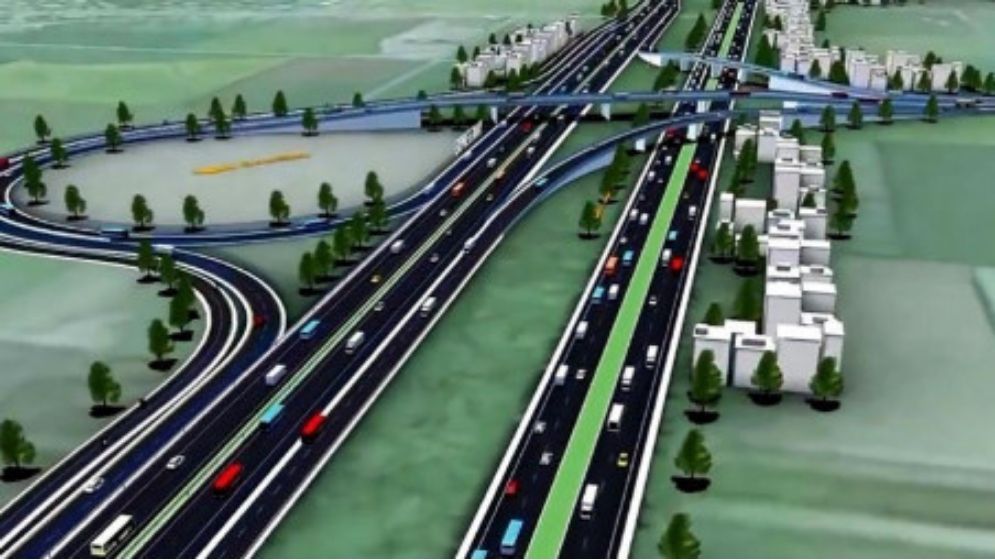
Bangladesh’s under-construction Dhaka-Ashulia Elevated Expressway has emerged as one of the world’s most expensive elevated highways in terms of construction cost per kilometre, despite offering fewer infrastructure features than comparable projects in other countries, according to transport experts.
China’s Yibin-Panzhihua Expressway, which became fully operational this year, stretches 427km, with nearly 90% of the route built as elevated sections. Constructed through mountainous terrain requiring numerous bridges and tunnels, it cost around 200 million yuan (approximately Tk365 crore) per kilometre, reports Bonik Barta.
Malaysia’s Damansara-Shah Alam Elevated Expressway (DASH), built at a cost of Tk630 crore per kilometre, incorporates advanced features including intelligent traffic management systems, solar power, rainwater harvesting, noise barriers, a multi-lane free-flow toll system and 13 interchanges.
India’s first eight-lane elevated highway, the Dwarka Expressway, cost around Tk320 crore per kilometre, according to the Comptroller and Auditor General of India. The project includes a direct airport connection through a 3.6km-long eight-lane tunnel, regarded as one of India’s widest urban tunnels.
Bangladesh is currently constructing two elevated expressways. The country’s first, the Dhaka Elevated Expressway, is being implemented under a public-private partnership (PPP), while the second, the Dhaka-Ashulia Elevated Expressway, is being financed through foreign loans.
The 24km Dhaka-Ashulia project has an estimated cost of Tk27,046 crore, translating into Tk1,127 crore per kilometre, placing it among the most expensive elevated expressway projects globally. The Development Project Proposal (DPP) was approved in 2017, while the commercial loan agreement with the Chinese contractor was signed in mid-2022 before construction began.
For comparison, Sri Lanka’s Port Access Elevated Highway is being built at Tk837 crore per kilometre, Indonesia’s Sheikh Mohammed bin Zayed Skyway cost Tk390 crore per kilometre, and Thailand’s Rama III Expressway was constructed at Tk612 crore per kilometre. These projects also feature modern infrastructure similar to those in China and Malaysia.
The Dhaka-Ashulia project includes a 24km elevated roadway, nearly 11km of ramps, the two-lane Nabinagar Flyover, a trumpet interchange at Baipayl, reconstruction of 14km of at-grade roads, bridges, overpasses, flyovers, modern drainage and utility ducts, and toll plazas.
Despite the high cost, transport infrastructure experts argue that the project falls short of international standards in terms of engineering quality, environmental safeguards and long-term sustainability.
Professor Dr Shamsul Hoque of the Bangladesh University of Engineering and Technology (BUET) said Bangladesh’s mega projects often cost more than international benchmarks without delivering comparable construction quality or environmental resilience.
“In many developed and emerging economies, environmental compliance, climate resilience and future expansion are treated as integral components of project budgets. In Bangladesh, although environmental impact assessments are conducted, implementation and monitoring remain weak. As a result, we spend enormous amounts but still fail to achieve international standards,” he told Bonik Barta.
Referring to the Dhaka Metro Rail project, he added that many modern metro systems worldwide incorporate future expansion, energy efficiency and integration with other transport infrastructure during the design stage, whereas such considerations have not received adequate attention in Bangladesh.
“The real evaluation of a project should not depend solely on construction cost per kilometre, but also on the engineering standards, environmental protection and long-term capacity ensured through that investment,” he said.
The Dhaka-Ashulia project’s estimated cost has increased significantly over time. Initially approved at Tk16,901 crore, the first revision raised it to Tk17,553 crore, while the second revision, approved by the Executive Committee of the National Economic Council (ECNEC) on 22 July, increased the total cost to nearly Tk27,046 crore.
Prof Dr Hadiuzzaman of BUET’s Department of Civil Engineering questioned whether the project remains financially viable after the sharp increase in expenditure.
“An expressway is not a social welfare project; it must be financially viable. If nearly Tk10,000 crore is added to the same project without any fundamental change in its objectives, key financial indicators, including the Financial Internal Rate of Return (FIRR), are expected to deteriorate,” he said.
He argued that land acquisition and cost escalation attributed to drainage works and utility relocation reflected serious shortcomings in the initial planning, particularly as both design and implementation remained under the same contractor.
“Following such a substantial increase in expenditure, an independent post-implementation evaluation should be carried out immediately to determine whether the project remains financially viable,” he added.
Project officials, however, defended the revised budget, saying the increase resulted from multiple factors rather than a single cause.
Project Director Md Shafiqul Islam said the cost had risen due to the depreciation of the taka against the US dollar, higher VAT, taxes and customs duties, relocation of utilities that were not included in the original DPP, design modifications requested by Bangladesh Railway and the Bangladesh Inland Water Transport Authority (BIWTA), changes in navigational requirements, and integration with the airport’s third terminal, the metro rail and the planned underground metro system.
Although the project’s cost increased by around Tk9,500 crore at the final stage of construction, policymakers did not comment on the matter.
Bonik Barta said it sought comments from Economic and Planning Adviser Dr Rashed Al Mahmud Titumir and State Minister for Planning Jonaid Abdul Rahim Saki, but neither responded.
Earlier, after the Ecnec meeting, State Minister for Planning Zonayed Abdur Rahim Saki said the increase was caused by changes in foreign exchange rates, revisions in VAT and tax calculations, relocation of utility lines omitted from the original DPP and the inclusion of five additional project components.
Comment
Design & Developed by: BD IT HOST


 |
29 July, 2026
|
29 July, 2026