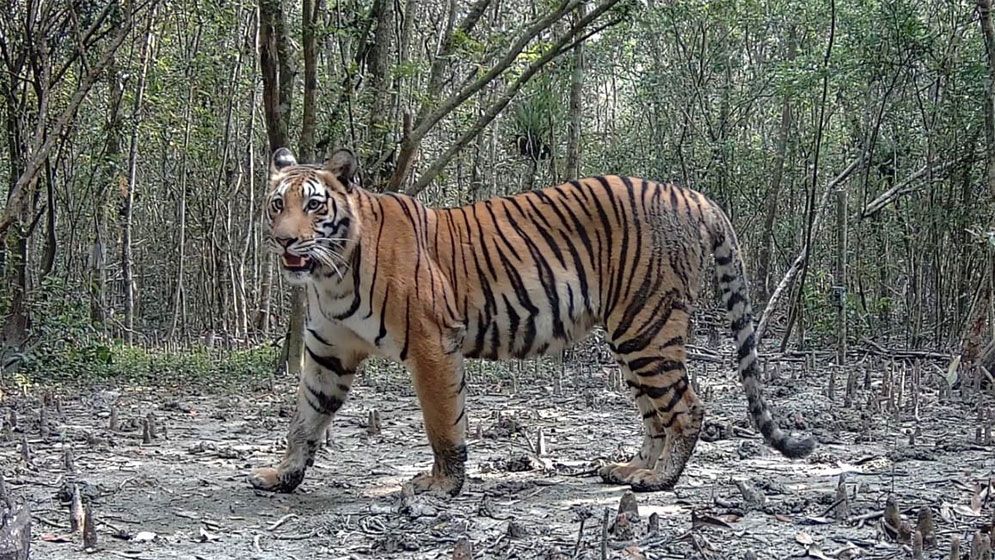
The population of Royal Bengal tigers in the Sundarbans is increasing, with sightings becoming more frequent than in previous years. An analysis of the last several tiger censuses shows that the population has grown by an average of around 10 tigers in each survey.
Last Friday (24 July), a Royal Bengal tiger was spotted roaming near the Andharmanik Ecotourism Centre in the Sundarbans. Forest officials recently analysed footage captured over a week by 20 camera traps installed in the area and identified three individual tigers.
The tendency of tigers to stray into nearby villages has declined, while conflicts between humans and tigers have also reduced. Forest officials and tourists visiting the Sundarbans are increasingly reporting sightings of pairs of tigers.
Despite these positive signs, the species remains under threat in the world’s largest mangrove forest. Poaching, climate change and the activities of forest-based criminal groups continue to pose serious risks. According to official records, 61 tigers have died in the Sundarbans over the past 25 years.
The Forest Department says tigers in the Sundarbans are now safer than at any previous time. Officials attribute this to intensified anti-poaching operations, expressing optimism that the next tiger census will record a further increase in the population. The most recent camera-trap survey estimated the tiger population in the Bangladesh section of the Sundarbans at 125.
Wildlife experts stress that without the Sundarbans, there can be no future for the Royal Bengal tiger. They say the government must adopt a long-term conservation strategy to protect both the forest and its iconic predator.
Wednesday (29 July) marks World Tiger Day. For the past several years, Bangladesh has observed the day nationally outside Dhaka to engage communities living near the Sundarbans. This year’s theme is: “Let’s all be aware and conserve tigers.”
Tiger population on the rise
According to the Forest Department, tiger surveys have been conducted using camera traps in recent years. The first such survey, carried out in 2015, estimated the tiger population at 106. A second survey in 2018 put the number at 114. The latest survey, completed in October 2024, recorded 125 tigers in the Bangladesh portion of the Sundarbans.
On 4 January this year, forest officials rescued a tigress from a poacher’s snare. The animal, believed to be around 10 years old, was in critical condition after being trapped for several days. Following treatment and rehabilitation, she was released back into the Sundarbans on 12 July, six months after her rescue.
Sixty-one tiger deaths in 25 years
According to the Sundarbans Forest Division, 61 tigers died between 2001 and 2025. Of these, 26 were killed by criminals, 14 were beaten to death after entering human settlements, 19 died of natural causes, and two died during Cyclone Sidr or from other causes. During the same period, authorities recovered tiger skins and bones from illegal traders.
Tiger attacks also claimed the lives of 13 people in the Sundarbans East Forest Division during this period. Of the 61 tiger deaths, 30 occurred in the eastern division and 31 in the western division.
Anti-poaching operations intensified
Md Rezaul Karim Chowdhury, Divisional Forest Officer (DFO) of the Sundarbans East Forest Division, said the department had strengthened efforts to protect tigers, deer and other forest resources.
He said regular foot patrols and drone surveillance were being conducted across the forest. Over the past year, authorities recovered a large number of snares used for hunting tigers and deer, arrested 70 deer poachers and prepared a list of 150 suspected poachers, which has been handed over to law enforcement agencies.
According to the DFO, these operations have significantly reduced poaching, leading to an increase in tiger activity across the forest.
He added that no tiger from the Sundarbans had died after entering nearby villages in recent years. Boundary fencing has helped prevent tigers from leaving the forest, while the growing deer population has ensured a stable food supply. Improved patrol methods have also reduced the presence of hunting traps.
“Tigers are now being seen along forest trails, beside ponds and canals, and even near Forest Department offices. Tourists are also reporting tiger sightings, including groups of three together. Overall, tigers are much safer now than before, and we expect their numbers to increase further in the next census,” he said.
A Z M Hasanur Rahman, DFO of the Sundarbans West Forest Division, said the department remained on constant alert to protect tigers and other forest resources.
He expressed confidence that the results of the ongoing conservation efforts would be reflected in future tiger surveys.
Experts call for long-term conservation
Kamal Uddin Ahmed, president of the Dubla Fishermen’s Group, said he had been involved in business in the Sundarbans for the past 50 years and had seen tigers more than 50 times.
He said breeding sites within the forest should be protected to ensure tigresses can give birth and raise their cubs safely.
Professor Dr Anwarul Islam, wildlife expert and Chief Executive of WildTeam, said tigers in the Sundarbans continued to face threats from climate change, poaching, the use of poison in fishing and the activities of forest-based criminal groups.
He noted that the forest itself was under increasing environmental pressure. Nevertheless, tiger numbers had not declined over the past 12 years and had instead shown a modest but steady increase.
“This is a significant achievement,” he said. “To ensure the long-term survival of the Royal Bengal tiger, Bangladesh must adopt a comprehensive conservation strategy to address all major threats.”
Professor Islam also warned that many rivers and canals flowing through the Sundarbans had become silted up. He said these waterways should be dredged regularly under a long-term management plan to maintain the ecological health of the forest.
Comment
Design & Developed by: BD IT HOST


 |
30 July, 2026
|
30 July, 2026