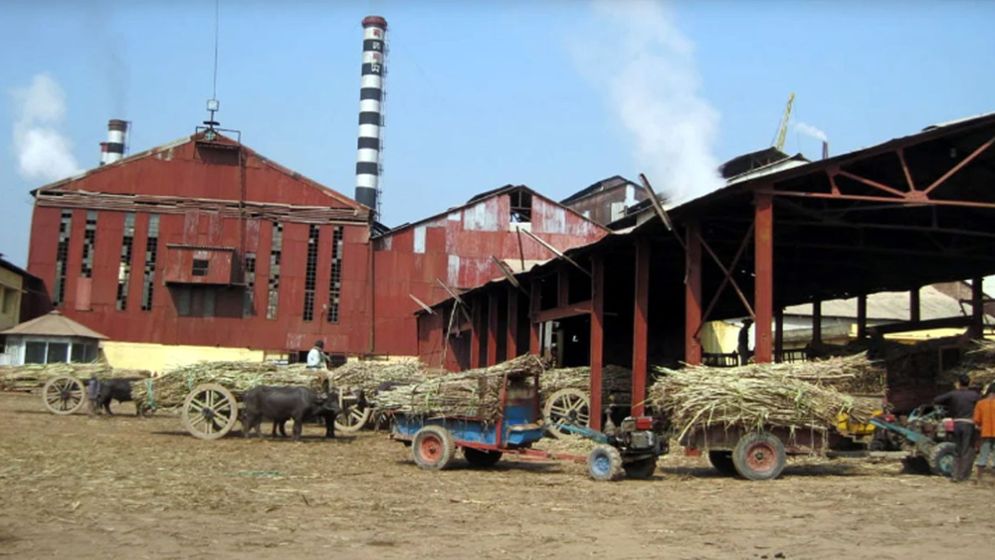
The government is close to finalising a new roadmap to attract private investment into 44 long-idle state-owned industrial and commercial enterprises, aiming to complete the entire investment approval process—from proposal submission to final agreement—within a maximum of 77 working days.
A high-level meeting held at the Ministry of Commerce on Tuesday discussed a streamlined framework designed to accelerate private sector participation in these dormant assets.
According to officials, the initiative seeks to revive production at long-shuttered state-owned factories, put idle public assets to productive use, and generate employment. To achieve this, the government has prepared a simplified flowchart and time-bound procedural framework for allowing private investment or partnerships in state-owned industrial and commercial assets.
Policymakers believe the initiative could significantly reduce the time and cost associated with establishing new industries. Since many of the closed factories already have land, buildings, utility connections and other infrastructure in place, investors would be able to begin production much faster than building new industrial facilities from scratch.
44 enterprises under five state corporations
Government data show that the 44 identified enterprises fall under five state-owned corporations. These include:
13 enterprises under the Bangladesh Sugar and Food Industries Corporation (BSFIC)
12 under the Bangladesh Textile Mills Corporation (BTMC)
10 under the Bangladesh Chemical Industries Corporation (BCIC)
Five under the Bangladesh Jute Mills Corporation (BJMC)
Four under the Bangladesh Steel and Engineering Corporation (BSEC)
Most of these factories have remained closed for years, while a few operate only on a limited scale. Their land, buildings, warehouses, gas and electricity connections, and other infrastructure have largely remained unused.
The government hopes to utilise nearly 10,000 acres of industrial land and existing facilities to promote industrialisation, create jobs and boost export capacity.
Three-stage approval process
According to the Bangladesh Investment Development Authority (BIDA), the proposed investment framework consists of three stages.
In the first stage, authorities will conduct a preliminary review within seven working days of receiving an investment proposal. Based on the assessment, the proposal will either be accepted, returned for revision or rejected.
The second stage, expected to take around 50 working days, will include asset valuation, negotiations, determination of the investment structure and due diligence. The Inter-Agency Public Asset Committee (IPAC) will play a key role during this phase.
In the final stage, the proposal will receive approvals from the relevant ministry, the Finance Division and, where necessary, the Cabinet Committee on Government Purchase (CCGP) or other high-level authorities. The investment agreement will then be signed and implementation will begin. This stage has been allocated an additional 20 working days.
Altogether, the government aims to complete the entire process within a maximum of 77 working days.
Opportunity to revitalise idle assets
Dr M Masrur Riaz, Chairman of Policy Exchange Bangladesh, said establishing a new industrial facility currently requires significant time and investment for land acquisition, infrastructure development and utility connections.
“Most of these facilities already have those essential services in place. As a result, new investors can begin production much more quickly while the government’s idle assets are brought back into productive economic use,” he said.
He added that many of the industrial units occupy thousands of acres of land with existing gas, electricity, water supply, road connectivity and industrial infrastructure, creating substantial opportunities for rapid reinvestment.
Potential impact on employment and exports
Business leaders believe the initiative comes at a time when industrial investment has slowed and could help stimulate economic activity.
If the factories resume operations, they expect thousands of direct and indirect jobs to be created. Fresh investment in jute, textiles, chemicals, food processing and engineering industries could also increase the production of import substitutes while expanding export-oriented manufacturing.
However, analysts cautioned that attracting investment alone would not guarantee success. They stressed the need for long-term policy stability, easier access to financing, reliable gas and electricity supplies, and faster public services to support investors.
Investment Bangladesh Act to strengthen investment climate
Speaking at the meeting, Industries Secretary Abdun Naser Khan said the government does not want these long-closed state-owned factories to remain idle assets.
“We have taken the initiative to attract new investment by making use of their land, infrastructure and existing facilities. Reviving these factories through private sector participation will create jobs, accelerate industrialisation and contribute positively to the national economy,” he said.
He added that the recently enacted Investment Bangladesh Act 2026 would further strengthen the country’s investment environment. Under the new law, the Bangladesh Investment Development Authority (BIDA), the Bangladesh Economic Zones Authority (BEZA) and the Public-Private Partnership Authority (PPPA) will be merged into a single entity called Invest Bangladesh.
The integrated institution is expected to streamline investment approvals, economic zone management and PPP activities, making it easier to attract both domestic and foreign investment into the 44 state-owned factories.
Policy decisions under consideration
Sources familiar with the meeting said discussions focused on the current condition of the 44 enterprises, investor interest, the approval framework and implementation timelines.
The government is also preparing policy decisions on whether the factories should be operated through long-term leases, joint ventures (JVs), public-private partnerships (PPPs) or direct private investment.
Business leaders and economists believe that if implemented successfully, the initiative could transform long-idle state assets into engines of industrial production, employment generation and export growth. They also warned that failure would mean another missed opportunity to revive Bangladesh’s state-owned industrial sector. As a result, the government’s new roadmap is being viewed as a potentially significant turning point for the country’s industrial development.
Source : Kaler Kantho
Comment
Design & Developed by: BD IT HOST


 |
29 July, 2026
|
29 July, 2026