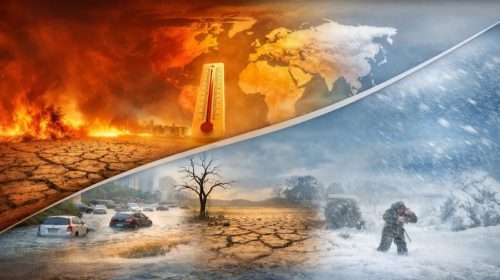
The world is on course to exceed the critical 1.5 degrees Celsius global warming threshold within the next four years unless greenhouse gas emissions are rapidly reduced, according to a major international climate assessment released Thursday.
The latest “Indicators of Global Climate Change (IGCC)” report found that human-induced warming reached 1.37°C above pre-industrial levels in 2025, underscoring how close the planet is to breaching the limit set under the Paris Agreement. Published in the journal Earth System Science Data, the report was prepared by more than 70 scientists from 56 institutions across 17 countries.
Researchers said one of the most alarming findings is the growing “Earth energy imbalance” — the gap between the amount of solar energy entering the planet and the amount escaping back into space. The indicator has reached a record high, showing that heat is accumulating in the climate system faster than ever.
The heat imbalance has been increasing since the 1970s and has nearly doubled in recent decades, reflecting the accelerating pace of climate change, said Prof Piers Forster, lead author of the report and director of the Priestley Centre for Climate Futures at the University of Leeds.
The report also found that global greenhouse gas emissions hit a record 56.8 billion tonnes of carbon dioxide equivalent in 2024, driven largely by continued reliance on fossil fuels.
Scientists said the rate of human-induced warming remains at an all-time high of 0.27°C per decade. Rising concentrations of greenhouse gases, combined with declining sulphur dioxide pollution that previously masked part of the warming effect, are contributing to the trend.
According to the study, nearly all of the warming observed over the past decade can be attributed to human activities.
“Our study demonstrates that nearly all of the warming over the last decade is driven by human activities,” said Dr Samantha Burgess of the Copernicus Climate Change Service.
She warned that the impacts of climate change are already being felt worldwide, affecting livelihoods, ecosystems and economies, and are expected to intensify as temperatures continue to rise.
The report noted that the remaining global carbon budget for limiting warming to 1.5°C has shrunk dramatically. As of the beginning of 2026, only 130 billion tonnes of carbon dioxide remained in the budget. At current emission levels, that allowance could be exhausted within about three years.
Scientists also highlighted accelerating sea-level rise. Global mean sea level reached a record 23 centimetres above 1901 levels in 2025, driven by warming oceans and the melting of land-based ice.
Marine heatwaves are becoming increasingly common as well. The world’s oceans experienced 65 marine heatwave days in 2025, while the number of such events has more than tripled since 1991.
Prof June-Yi Lee of Pusan National University in South Korea said warmer ocean temperatures are fuelling more frequent marine heatwaves, threatening marine ecosystems, food security, coastal protection and economic activities.
The report further showed that atmospheric concentrations of major greenhouse gases continued to rise in 2025. Carbon dioxide concentrations reached 425.6 parts per million (ppm), methane 1,936.3 parts per billion (ppb), and nitrous oxide 339.4 ppb.
Although the growth rate of emissions has slowed compared with the early 2000s, researchers stressed that current efforts remain far from sufficient.
“The Earth is accumulating heat faster than ever before,” said Dr Matt Palmer of the UK Met Office. “We are emitting more greenhouse gases than ever, trapping more heat in the atmosphere and pushing the climate system further out of balance.”
The scientists also warned that funding cuts to climate monitoring programmes could undermine future assessments and weaken evidence-based policymaking at a time when reliable climate data is increasingly critical.
The findings add to growing concerns among scientists that the window for keeping global warming within internationally agreed limits is rapidly closing, making deeper and faster emissions cuts essential during this decade.
Comment
Design & Developed by: BD IT HOST


 |
12 June, 2026
|
12 June, 2026