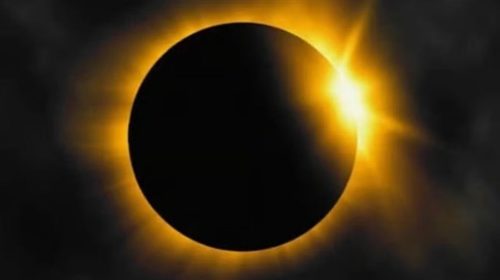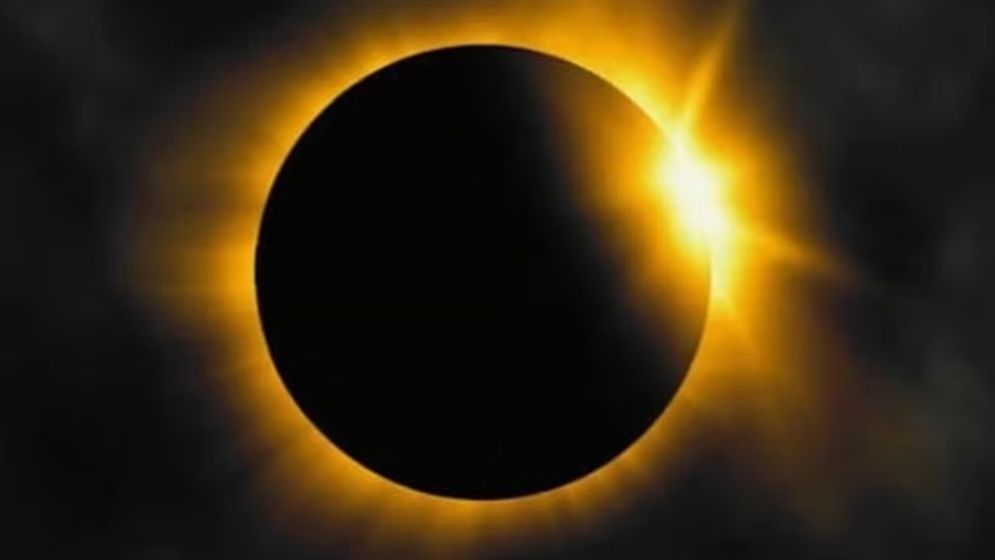
On the afternoon of 2 August 2027, something remarkable will happen over Saudi Arabia. For a few minutes, day will turn into night. The Moon will completely cover the Sun, the air will cool, stars will appear in the daytime sky, and the Sun’s glowing outer ring, called the corona, will become visible.
This is not an ordinary eclipse. It is one of the longest total solar eclipses of the entire 21st century, and the first one to cross the Kingdom in more than 75 years. The Saudi Space Agency has called it the most significant astronomical event of the century.
Why Saudi Arabia will see it
A total solar eclipse happens when the Sun, the Moon, and the Earth line up perfectly, with the Moon in the middle. By a lucky coincidence of nature, the Moon is about 400 times smaller than the Sun but also about 400 times closer to us. So from the ground, both look almost exactly the same size. When they line up perfectly, the Moon blocks the Sun completely and casts its shadow on the Earth.
That shadow is very small compared to the planet. It moves across the Earth in a narrow strip, usually only a couple of hundred kilometers wide. This strip is known as the path of totality. Everyone inside it sees a total eclipse. Everyone outside it sees only a partial one. This is why total eclipses feel so rare. One happens somewhere on Earth about every 18 months, but any single place waits centuries, on average, for its turn.
In 2027, that strip lands on Saudi Arabia. The Moon’s shadow will start over the Atlantic Ocean, race across North Africa and Egypt, then cross the Red Sea and sweep over western and southern Saudi Arabia before moving on toward the Indian Ocean. The Kingdom simply sits directly under the shadow’s path at exactly the right moment. That has not happened in over 75 years.
Why this eclipse lasts long
The timing makes this eclipse special. In early August, the Earth is near its farthest point from the Sun, so the Sun looks slightly smaller in the sky. At the same time, the Moon will be near its closest point to Earth, so it looks slightly bigger. A bigger Moon covering a smaller Sun means the darkness lasts longer than usual.
The longest darkness anywhere in the world, just over six minutes, will happen in neighboring Egypt. But Saudi Arabia is close enough to enjoy almost the same experience.
According to the Saudi Space Agency, total darkness will last approximately six minutes in southern areas like Abha, and about five minutes and 50 seconds in Jeddah and parts of the western coast. This gives researchers and enthusiasts a prime opportunity to study the solar corona. For comparison, many total eclipses last barely two minutes, and eclipse chasers fly across the world for less.
Where the shadow will fall
According to Engineer Majed Abu Zahra, President of the Jeddah Astronomy Society, the shadow will pass directly over many major cities. Mecca, Jeddah, Taif, Al Baha, Khamis Mushait, Jizan, and Najran all sit inside the path of totality.
Many smaller towns will see it too, including Tuwal, Dahban, Asfan, Khulais, Jumum, Bahrah, Al Hada, Al Shafa, Al Leith, Al Mandaq, Baljurashi, Majardah, Al Qunfudhah, Sabt Al Alaya, Al Namas, Tanuma, Bariq, Ahad Rafidah, Baish, Sabya, Dhahran Al Janoub, and Sarat Abidah.
The rest of the country will not miss out completely. The central, eastern, and northern regions, including Riyadh and the Eastern Province, will see a partial solar eclipse, with the Sun covered by up to 80% in some areas. Exact timings and coverage will vary by location.
When to look up
The whole event takes just over three hours. The first partial phase begins at 11:41am Arabia Standard Time, and the eclipse ends by around 3:00pm. Total darkness sweeps across the country between 1:21pm and 1:44pm.
City by city:
Jeddah: Partial phase begins at 12:00 noon. Totality starts at 1:25pm. The eclipse ends at 2:43pm.
Mecca: Partial phase begins at 12:01pm. Totality starts at 1:26pm. The eclipse ends at 2:44pm.
Taif: Partial phase begins at 12:03pm. Totality starts at 1:28pm. The eclipse ends at 2:45pm.
Khamis Mushait: Partial phase begins at 12:13pm. Totality starts at 1:37pm. The eclipse ends at 2:54pm.
What it will feel like
In the final seconds before totality, the light turns silvery. Shadows sharpen. Then, suddenly, darkness falls. Twilight rushes in from the horizon, the temperature drops, and bright stars and planets appear in the middle of the day.
In the centre of the dark sky hangs the eclipsed Sun, a black circle surrounded by the white glow of the corona. This outer layer of the Sun is normally hidden by daylight. It only shows itself during these few precious minutes, which is why scientists value a six-minute eclipse so highly.
This is also why location matters so much. At 99 %t coverage, the sky dims but the real show never starts. You are either inside the path of totality, or you are not. If you can travel, it is worth being inside it.
Where to watch
It’s simple. Get inside the path of totality, and stay as close as you can to its center line, the imaginary line running down the exact middle of the strip. The Moon’s shadow is roughly circular as it moves across the ground. A spot on the centre line sits under the full width of the shadow, so the darkness lasts the longest there. Places near the edges of the path get only a brief pass, sometimes just a few seconds. Luckily, the 2027 center line runs close to Jeddah, Mecca, and the southern highlands.
Jeddah and the Red Sea coast: The easiest choice for most visitors. It has a major airport, plenty of hotels, and about five minutes and 50 seconds of darkness. Open beaches offer wide, clear views of the sky.
The highlands around Abha and Khamis Mushait: The longest darkness in the Kingdom, at approximately six minutes. The high altitude usually means clearer air, but check the forecast, since afternoon clouds can form over the mountains in August.
Taif and Al Baha: Cooler mountain weather and comfortably inside the path. A good pick for anyone who wants to escape the summer heat.
Open desert within the path: Best for photographers. A flat horizon away from city buildings gives the most dramatic view of the shadow moving across the land.
Local astronomy groups, including the Jeddah Astronomy Society, are expected to hold public viewing events with telescopes and certified equipment. These are perfect for families and first-time observers.
If you cannot travel, major space agencies and observatories usually stream total eclipses live online. A screen is not the same as the sky, but it is the next best thing.
Will the UAE see it?
Yes, but only partially. The path of totality passes several hundred miles to the west and southwest of the Emirates. Dubai sits roughly 830 miles away from it, so the country will not experience total darkness.
Instead, the UAE will see a partial eclipse. In Dubai, the Moon will cover about 53% of the Sun, from 1:33 pm to 3:48pm local time. Areas further west and south in the country will see slightly more coverage, up to around 61%.
The Sun will shrink into a thick crescent and the afternoon light will soften. But there will be no darkness, no corona, and no daytime stars. Those belong only to the path of totality.
How to watch safely
The Saudi Space Agency has stressed one thing above all. Never look directly at the Sun without proper protection. Doing so can cause permanent eye damage, and no stage of a partial eclipse is ever safe for the naked eye.
The basic rules:
Use only certified solar eclipse glasses. Regular sunglasses, no matter how dark, do not protect your eyes.
Check your glasses before use. Throw them away if they are scratched or damaged.
Never point binoculars, telescopes, or cameras at the Sun without a proper solar filter. Focused sunlight can destroy the equipment and your eyesight in seconds.
Keep your glasses on during all partial phases. The only safe time to look with bare eyes is during totality itself, when the Sun is fully covered. The moment sunlight returns, the glasses go back on.
For one afternoon in August 2027, a strip of Saudi Arabia becomes one of the best places on Earth to watch the sky’s greatest show. Whether you stand under the full shadow in Jeddah or watch a crescent Sun from Dubai, this is one appointment with the cosmos worth keeping.
Comment
Design & Developed by: BD IT HOST


 |
1 Augustust, 2026
|
1 Augustust, 2026