Religious leaders are set to be engaged in efforts to raise awareness about nutrition among children, adolescent girls, pregnant women and mothers, as well as early childhood care and development.
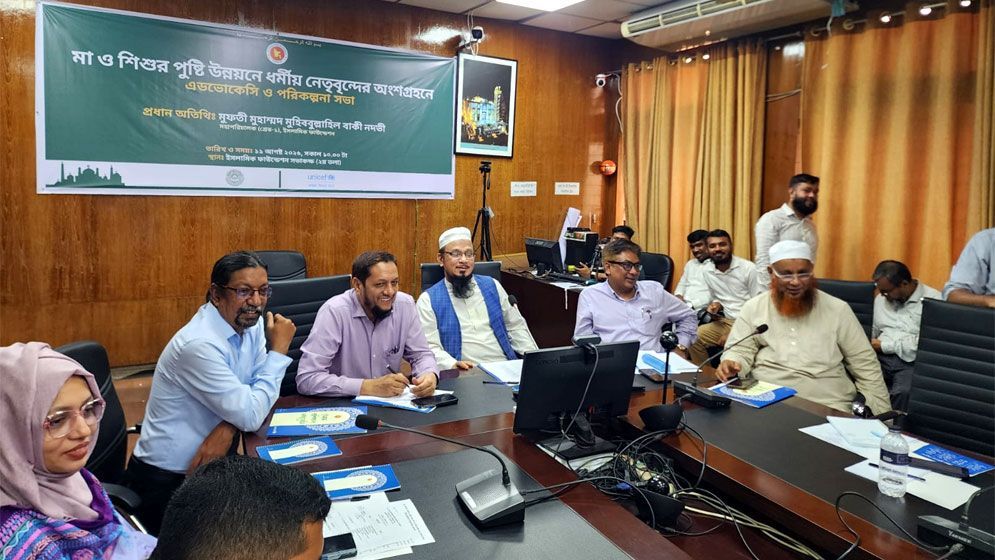
An advocacy meeting on the issue was held jointly by UNICEF and the Islamic Foundation at the foundation’s meeting room in Dhaka on Tuesday morning.
Mufti Muhammad Muhibbullahil Baki, the director general (DG) of the Islamic Foundation Bangladesh, said religious leaders are respected and trusted members of society and can play a positive role not only in religious matters but also in family and social life.
“Ensuring the health and nutrition of mothers and children is a humanitarian and social responsibility. The Islamic Foundation is keen to strengthen awareness activities by engaging religious leaders in this effort,” he said.
He said ensuring children’s healthy growth, mothers’ wellbeing and proper nutrition for adolescent girls required collective efforts by government health services, families, educational institutions, religious institutions and communities.
Speakers at the meeting said healthy mothers and children were among the key foundations for building a healthy, skilled and prosperous Bangladesh.
They stressed the need to engage families, society and communities in ensuring maternal and child health, nutrition and early development.
They said imams, khatibs, Islamic scholars and other religious leaders associated with mosques, madrasas and other religious institutions can play an important role in this regard.
Through Friday sermons, religious gatherings, religious education, family counselling and social interactions, they can provide people with accurate information on maternal and child health and nutrition, the speakers said.
The meeting was informed that the Ministry of Health and Family Welfare, the Institute of Public Health Nutrition and various government and non-government organisations were working to improve maternal and child health and nutrition in Bangladesh.
Health and nutrition services are being provided to mothers and children through primary healthcare facilities, including community clinics, union health and family welfare centres and upazila health complexes.
Citing findings from the 2025 Bangladesh Multiple Indicator Cluster Survey (MICS) and other surveys and studies, speakers said malnutrition among pregnant and postpartum women, adolescent girls and children aged 0-3 remained a significant challenge.
They also noted a lack of accurate information about nutrition at family and community levels.
In many cases, misconceptions and superstitions were creating risks to the health and nutrition of mothers and children, the meeting was told.
The advocacy meeting placed particular emphasis on five areas of maternal and child nutrition and development: nutrition and multiple micronutrient supplementation (MMS) for pregnant and postpartum women; nutrition for children aged 0-23 months; adolescent nutrition; early childhood care and development; and prevention of overnutrition and obesity among children.
Religious leaders shared their views, experiences and recommendations on these issues. Based on their input, participants stressed the need to develop simple, accessible and acceptable information materials for raising awareness at community level.
Speakers said the social acceptance of religious leaders could be used to dispel misconceptions about maternal and child nutrition and encourage people to adopt appropriate health and nutrition practices.
They also stressed the importance of coordinated efforts by the Islamic Foundation and UNICEF, saying the involvement of religious leaders can help create a strong link between healthcare services and communities.
Officials and representatives from the Islamic Foundation, UNICEF, the Institute of Public Health Nutrition and other relevant organisations attended the meeting.
The programme concluded with prayers for the welfare and prosperity of the country and its people.
Comment
Design & Developed by: BD IT HOST


 |
12 Augustust, 2026
|
12 Augustust, 2026