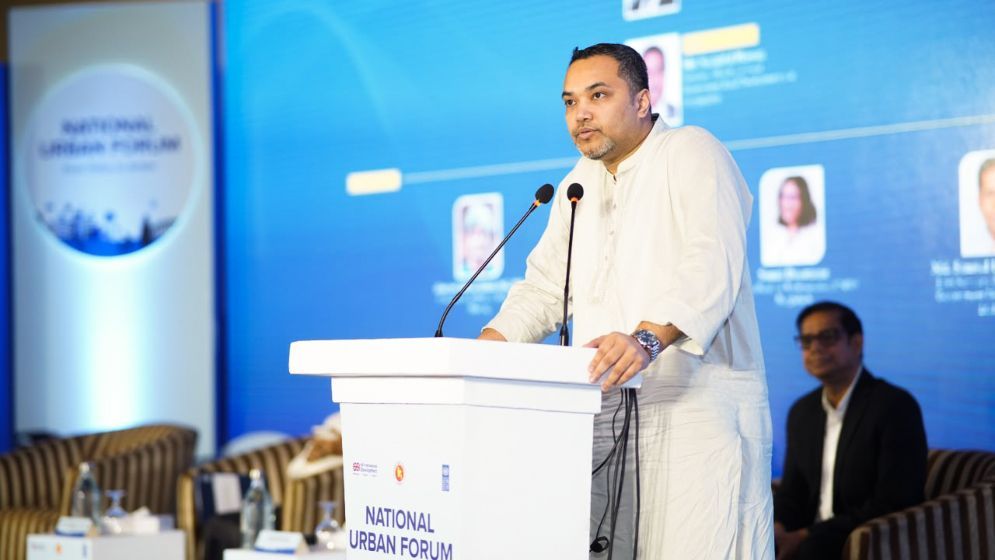
The government’s goal is not to build bigger cities but to create a people-centred and environmentally friendly urban system, Spokesperson at the Prime Minister’s Office Mahdi Amin has said.
“We want cities that bring genuine and visible improvements to people’s lives, where opportunities, justice and equality are ensured for all, and development takes place in harmony with nature while protecting the environment and water bodies,” he said.
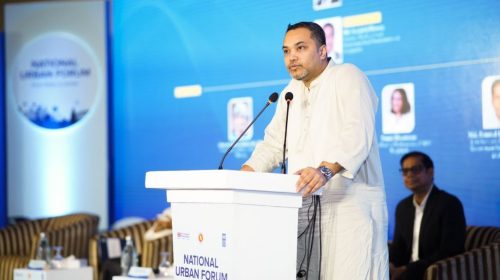
Mahdi Amin, also Prime Minister’s Adviser, made the remarks at the closing ceremony of the two-day National Urban Forum 2026 at Hotel Sonargaon in Dhaka on Monday (7 September) night.
He said cities were a key driver of the national economy, with around one-third of Bangladesh’s population living in urban areas that generate nearly two-thirds of national GDP.
However, rapid and unplanned urbanisation was putting severe pressure on housing, public transport, water supply, sanitation, waste management and the environment. Climate change, rising inequality and climate-induced migration were making the challenges worse, he said.
Amin said sustainable urban development should not be measured by the number of skyscrapers or kilometres of roads built, but by how significantly and sustainably people’s quality of life improves.
He stressed that formulating sound urban policies was only the beginning, with their effective and sustainable implementation being the real test.
Strong coordination among the central and local governments, city corporations, municipalities, development authorities, the private sector, researchers, development partners and civil society was essential, he said.
Calling for a “360-degree holistic approach”, Amin said urban planning must integrate housing, transport, drainage, water and waste management, energy, employment, healthcare and education.
He also called for stronger local institutions and an inclusive urban system ensuring safe water, sanitation, quality healthcare, affordable education, reliable electricity, modern public transport and decent employment for all.
“These services are not luxuries; they are the constitutional and fundamental rights of every citizen,” he said.
Amin urged climate resilience to be prioritised in every stage of urban planning, with rivers, canals, wetlands, open spaces and green areas treated as part of an integrated system. He also advocated nature-based solutions to tackle waterlogging, extreme heat and biodiversity loss.
He said policymaking should combine grassroots experiences with global practices through continuous dialogue and ensure that every voice is heard.
Highlighting cities as centres of economic opportunity, Amin called for greater investment, entrepreneurship, innovation, local revenue generation and stronger public-private partnerships to create dignified jobs for young people and improve connectivity between major cities and surrounding areas.
He also stressed the effective use of technology and artificial intelligence to improve civic services, while warning that technology must remain a means to improve people’s lives rather than an end in itself.
Amin said the challenges left by 16 years of authoritarian rule could not be resolved overnight, but stressed the government’s strong political commitment to achieving practical and sustainable solutions.
He said the forum’s theme, “From Policy to Action”, reflected the vision of the newly elected government, which took office six months ago with a strong public mandate.
“The cities we build today on a well-planned and sustainable foundation will ultimately determine what kind of Bangladesh we want to see in the future,” he said.
The forum was jointly organised by the Local Government Division, UNDP and the UK Government. Local Government, Rural Development and Cooperatives Minister Dr Abdul Moyeen Khan and UNDP Bangladesh Deputy Resident Representative Sonali Dayaratne, among others, also spoke.
Comment
Design & Developed by: BD IT HOST


 |
8 Septembertember, 2026
|
8 Septembertember, 2026