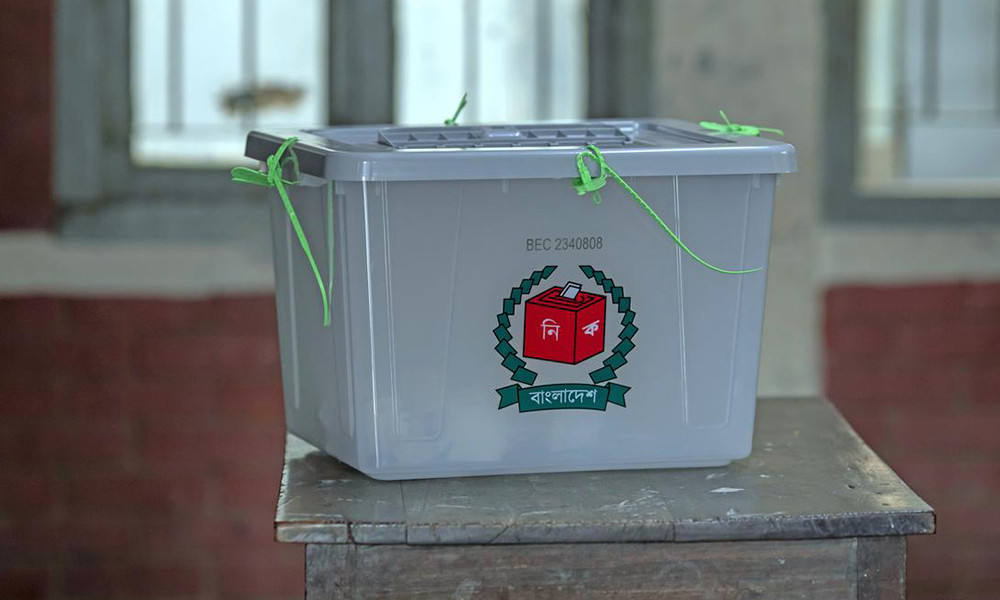
Bangladesh’s politics seems to be trapped in the maze of the referendum. Disagreements over when the referendum will be held are at their peak, and confusion about how it will be conducted is widespread among the public. The recommendations of the National Consensus Commission have only deepened this confusion.
The draft of the July National Charter (Constitutional Reform) Implementation Order 2025 states that a referendum will be held on the constitutional reforms included in the July National Charter. The order and the part of the Charter related to constitutional reforms, as listed in its schedule, will be presented in the referendum to exercise the people’s sovereign power. For holding the referendum, necessary legal measures will be enacted by the Election Commission.
The ballot will contain the question: “Do you express your consent to the July National Charter (Constitutional Reform) Implementation Order 2025 and the proposed constitutional amendments included in its Schedule-1?” Voters will mark ‘Yes’ or ‘No’ on the ballot paper and place it in the designated box.
Schedule-1 includes 48 proposed amendments to the Constitution discussed by the Commission. Although the July Charter signed on October 17 included ‘notes of dissent’ from several political parties, these were omitted in the final schedule. This is where the controversy lies. Not all political parties agreed to all 48 proposals. At least 11 parties, including the BNP, had given notes of dissent on several issues. When the political parties signed the July Charter on October 17, these notes were mentioned in the document. Even with these dissents, 24 parties signed the Charter. But the recommendations for implementation ignored those objections.
The question arises—what will parties like the BNP, which opposed proposals such as reducing the Prime Minister’s powers or turning the Anti-Corruption Commission into a constitutional body, do now? If BNP supporters vote ‘Yes’, they will be forced to accept issues they opposed. This referendum question, therefore, seems like a deceptive attempt to force BNP into saying ‘Yes’. On the other hand, if the BNP and other dissenting parties vote ‘No’, they will be branded as opponents of the July Charter. In other words, if you disagree with just one proposal—say, the proportional representation system for the upper house—you have no option to object selectively; you must either accept or reject all 48 proposals. Instead of unity, this referendum seems designed to deepen division.
If BNP and other dissenting parties stand together against the July Charter, what will happen then? Was this the intention behind the Commission’s referendum question—to divide the nation and create unrest? The National Consensus Commission has not only disregarded political parties’ objections but also kept citizens in the dark about the contents of these proposals. There are 48 in total—how many citizens even know about them? That’s why the Chief Adviser has said that the July Charter must be communicated to the people in every household before holding a referendum. Otherwise, it will be nothing but deceiving the nation.
Our past experience with referendums has not been pleasant. Since independence, Bangladesh has held three referendums—two administrative and one constitutional. The first was under President Ziaur Rahman in 1977, the second under President Hussain Muhammad Ershad in 1985, and the third on September 15, 1991.
The first referendum was held on May 30, 1977, to legitimize Ziaur Rahman’s rule as President after assuming office from his previous role as Army Chief. The question was whether citizens had confidence in President Major General Ziaur Rahman and his policies and programs. Zia announced the referendum on April 22, 1977, in a national broadcast. According to reports in *The Daily Ittefaq* on May 31, voting was conducted across 21,685 centers, with a total of 38.4 million voters. The official result claimed 88.1% turnout, with 98.9% voting ‘Yes’ and 1.1% voting ‘No’.
This referendum was widely questioned. Even President Ziaur Rahman himself was reportedly surprised and displeased by the inflated results. The late journalist and researcher Mahfuz Ullah wrote in his book *President Zia of Bangladesh: A Political Biography* that “Zia was also surprised by the number of votes cast” (p. 71).
The second referendum was held on March 21, 1985, under President and Chief Martial Law Administrator Lt. General Hussain Muhammad Ershad. It sought to determine public confidence in his policies and his continuation in office until elections were held under the suspended constitution. As before, the ballot offered ‘Yes’ or ‘No’ options, with Ershad’s photo printed beside the ‘Yes’ box. According to the Election Commission, turnout was 72.2%, with 94.5% voting ‘Yes’. The BBC described the results as “ridiculous and unbelievable.” BBC’s Dhaka correspondent Ataus Samad remarked that polling centers had been empty all day, yet the result claimed 72% turnout.
Following the 1990 mass uprising, military ruler Ershad resigned on December 6, 1990. Three months later, on February 27, 1991, the fifth parliamentary elections were held, which BNP won. To transition from a presidential to a parliamentary system of government, a bill was unanimously passed in parliament on August 6, 1991. The referendum held on September 15, 1991, asked whether Acting President Justice Shahabuddin Ahmed would assent to the Twelfth Amendment establishing a parliamentary democracy. According to The Daily Ittefaq, 35.2% of eligible voters participated; 84.38% voted ‘Yes’, while 15.62% voted ‘No’. Though credible, the referendum raised ethical questions as nearly two-thirds of voters did not participate.
Before that referendum, a Referendum Act had been passed in parliament. Its preamble stated that since amendments to certain key constitutional provisions required public assent under Article 142(1A), it was deemed proper and necessary to enact this law to allow referendums on such questions.
Twenty years later, under the Awami League government, the Fifteenth Amendment of 2011 abolished the provision for referendums. But following the July uprising, on December 17, 2024, the High Court reinstated both the caretaker government system and the referendum provision through its verdict overturning that amendment.
This too has sparked debate. In a democracy, the executive, legislature, and judiciary are independent branches of government. One should not interfere in another’s domain. Questions have arisen about whether an appellate court verdict automatically takes effect and whether such decisions may face future challenges.
Therefore, the most prudent and democratic approach would be to leave implementation of the July Charter to an elected government. Let a free, fair, and impartial election be held first. The new parliament can then decide which provisions to keep or amend. Holding a referendum now, while keeping citizens in the dark, will only destabilize the nation and turn the July Charter itself into a subject of controversy.
The writer is a playwright and columnist. Email: auditekarim@gmail.com
Facebook Comments Box
Comment
Latest
Popular
NBR moves to bring 3 crore retail shops under tax net
1
Capital springs back to life as holidaymakers return
2
Major questions over implementation capacity of ambitious budget
3
Police use batons, tear gas to disperse protesters


 |
3 June, 2026
|
3 June, 2026