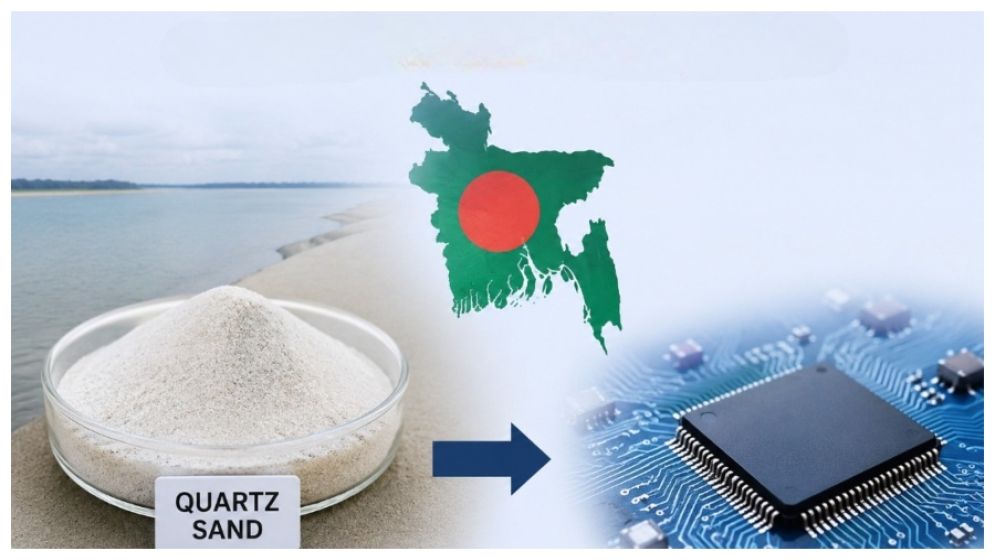
Bangladesh could emerge as a semiconductor hub by 2050 by harnessing its abundant quartz-rich river sands and developing capabilities across the global semiconductor value chain, according to a recent review study.
The Brahmaputra-Jamuna, Padma and Teesta rivers contain large deposits of quartz-rich sand. Proper utilisation of these resources could enable Bangladesh to become an important supplier of materials to the global semiconductor industry, according to the study by Dr Md Sohel Rana, deputy director of the Bangladesh Geological Survey.
Semiconductor chips are the backbone of modern technologies, including artificial intelligence (AI), 5G communications and electric vehicles. As global demand for semiconductors continues to grow, Bangladesh has an opportunity to establish a foothold in the rapidly expanding industry.
Quartz-rich river sands offer an opportunity
The study says Bangladesh’s major rivers, which originate in the Himalayas, carry and deposit substantial quantities of quartz-rich sand.
Quartz is an important starting material for producing silicon and semiconductor components. Laboratory tests have shown that ordinary processing of the country’s river sand can produce silica with a purity of up to 99.5%, making it suitable for applications such as glass manufacturing.
However, semiconductor-grade silicon materials require much higher purity. Achieving the required level — around 99.99% purity or higher, depending on the application and processing stage — would require advanced refining technologies and more detailed geochemical analysis.
Experts have therefore recommended that Bangladesh adopt a gradual approach instead of immediately investing billions of dollars in large-scale semiconductor fabrication plants, or fabs.
They suggest that the country should initially focus on producing high-purity silica, developing integrated circuit (IC) design capabilities and expanding semiconductor assembly and testing facilities.
Such a strategy could reduce investment risks while creating employment opportunities for a large number of engineers and other skilled professionals.
Five-step roadmap for semiconductor industry
The research paper proposes a five-stage long-term roadmap aimed at making Bangladesh more self-reliant in the semiconductor sector.
The first stage would involve a nationwide quartz exploration programme and the establishment of a specialised Sand Processing and Research Centre.
The second stage would focus on the commercial production of high-purity silica and strengthening the country’s IC design capabilities.
The third and fourth stages would involve launching pilot wafer fabrication and eventually establishing domestic chip manufacturing facilities, while integrating Bangladesh into the global semiconductor supply chain.
The fifth stage envisages the development of an innovation-driven, high-technology economy and Bangladesh’s emergence as a global leader in the semiconductor industry.
Challenges and opportunities
The study identifies the lack of advanced mineral-processing infrastructure and intense competition in international markets as two of the major challenges to achieving the goal.
Bangladesh, however, has significant advantages, including a large pool of young engineers and comparatively competitive labour costs.
The study suggests that the government could help develop the sector by introducing appropriate tax incentives, facilitating international technology transfers and adopting sustainable policies for managing mineral resources.
According to Dr Sohel Rana, semiconductors are no longer merely commercial products but have become strategic national assets.
If Bangladesh can effectively combine its geographical resources, particularly quartz-rich river sands, with its human capital, the country could become an important participant in the global semiconductor revolution by 2050.
The successful implementation of such a long-term strategy could not only ensure more effective utilisation of Bangladesh’s mineral resources but also help accelerate the country’s transition towards a knowledge-based, high-technology economy.
Source: Kaler Kantho
Comment
Design & Developed by: BD IT HOST


 |
11 Augustust, 2026
|
11 Augustust, 2026