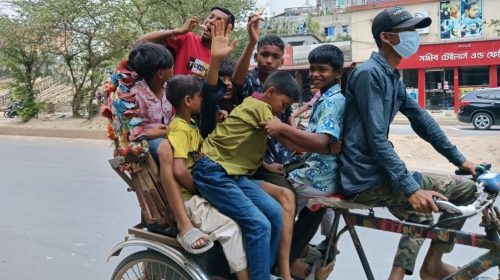
The movement of battery-powered rickshaws has increased at an alarming rate in the capital. From narrow lanes in residential neighbourhoods to major roads, their presence is now widespread. Battery-powered rickshaws are much faster than conventional pedal-run rickshaws. However, their braking systems are extremely weak, often resulting in accidents. As a result, these vehicles have now become a source of serious fear for city dwellers.
Battery-powered rickshaws have emerged as a much-discussed and controversial addition to the country’s public transport system over the past few years. While these vehicles have made commuting easier, they have also raised major concerns over road safety.
According to data from the Bangladesh Road Transport Authority (BRTA) and various transport organisations, more than 60 lakh battery-powered auto-rickshaws are operating across the country. Of these, around 10-12 lakh are operating in the capital Dhaka alone.
The chassis and braking systems of conventional pedal rickshaws are designed for speeds of 10 to 15 kilometres per hour. Later, batteries and motors were added to these rickshaws to increase their speed. Now, battery-powered rickshaws can travel at speeds of up to 30 to 50 kilometres per hour. However, their braking systems are not compatible with such speeds.
Avoiding traffic signals or driving on the wrong side of the road to reach destinations faster has become a regular habit among the drivers of battery-run rickshaws, also known locally as auto-rickshaws. Accidents frequently occur when they try to squeeze through gaps between other vehicles at high speed. Rickshaws often overturn because of excessive speed. There have also been incidents of drivers losing control and running over pedestrians.
Morshed Alam, a private-sector employee who lives with his family in a rented house in the capital’s Bhatara area, shared his experience with Daily Sun. He said, “About a few months back, I was travelling by a batter-run rickshaw with my child from Notun Bazar to the Suvastu Shopping Mall. As it was a holiday, the road was relatively empty. The driver was travelling quite fast. Suddenly, another rickshaw appeared in front of us. Although our driver applied the brakes, the vehicle did not stop. It crashed hard into the other rickshaw. I was thrown to the side along with my child. By the special grace of Allah, we escaped without serious injuries. If it had been a bus instead of a rickshaw, we could have met with a major accident. Batteries have certainly increased the speed of these rickshaws, but the braking system should also be upgraded. Otherwise, they are not suitable for operating on big roads.”
Outside the gate of Evercare Hospital in the capital, Daily Sun spoke to a pedestrian, Abdul Hakim. He said, “Auto-rickshaws are very convenient for travelling quickly. But the drivers have no training. Anyone can come along without any experience or training and take an auto-rickshaw onto the road. And the speed-control system is extremely poor. As a result, road accidents are occurring frequently. Motorbike accidents are particularly common because of these rickshaws.”
Ariful Islam works as a senior reporter for a private media outlet. He uses his personal motorcycle to commute to work. During a conversation, he said he recently narrowly escaped a major accident caused by an auto-rickshaw. After work, he was riding his motorcycle from Old Dhaka to his home in Chholmaid, Bhatara. When he reached the Bangabazar Market area, he came up behind an auto-rickshaw and tried to overtake it with the motorbike’s superior speed. However, the auto-rickshaw driver appeared reluctant to see Ariful ahead of him, and pushed sideways, causing the bike to collapse on the road.
Ariful fell off his motorcycle and sustained injuries to different parts of his body. His motorcycle was also damaged.
Ariful Islam further said, “As auto-rickshaws are outside the legal framework, no one follows any rules. They are dominating the roads like thugs. Even when police catch them, they cannot file cases against them due to lack of a comprehensive legal framework. Often, the drivers are simply reprimanded and let go. Besides, these auto-rickshaws have slowed down other vehicles, including buses, motorcycles and private cars. Wherever you turn on the road, you see rickshaws— in front, behind, and on both sides. As a result, even when vehicles have the capacity to move faster, they cannot use that speed. This creates traffic congestion.”
Daily Sun also spoke to a driver of a Bihanga bus operating on the Sadarghat-Gazipur route. He said, “Auto-rickshaws are like thugs on the road. We cannot increase the speed of our vehicles because of them. They drive right in front of us. They have no signalling system. They suddenly overtake from behind without giving any warning. They know nothing about road rules and regulations. They do not face any serious consequence such as arrest. They drive very recklessly. All the rules and regulations seem to apply only to us. Even for minor violations, we are fined heavily. Alongside the bus drivers, the government should also bring auto-rickshaws under a proper regulatory framework.”
Regarding the issue, DMP Additional Commissioner (Traffic) Anisur Rahman told Daily Sun, “We are facing the greatest difficulty with auto-rickshaws. We cannot control them in any way. As they are not within a proper legal framework, we cannot file cases against them. There is only one law that states they cannot drive on major roads or highways. For violating this law, they are being regularly fined and their vehicles are being dumped. However, they still do not face imprisonment. Furthermore, due to the lack of adequate licensing process and regulatory oversight, their number is increasing at an alarming rate, making it difficult to keep them off major roads. Work is underway at the ministry to formulate a policy on auto-rickshaws. Hopefully, we will be able to reach a decision soon in consultation with all relevant stakeholders.”
Md Enzamul Haque, general secretary of the Road Safety Movement (RSM), told Daily Sun that the number of auto-rickshaws in the country is increasing at an alarming rate. More than 10 lakh auto-rickshaws are now operating in the capital, and the actual number could be much higher. “In particular, the number of battery-powered rickshaws in Dhaka has increased nearly fourfold compared with the period before the mass uprising in 2024. These auto-rickshaws are not suitable for operating on highways. Yet, a huge number of them are operating on Dhaka’s main roads, in breach of the regulation that still applies to them, resulting in frequent accidents.”
“We have been campaigning against the operation of auto-rickshaws on highways for many years. In particular, the previous government, the one before the 2024 uprising, did not take any significant action on the issue. Later, during the interim government’s tenure, auto-rickshaws moved from narrow lanes onto Dhaka’s main roads. Since then, their numbers have increased dramatically,” he said.
Asked where the batteries used in the millions of auto-rickshaws being manufactured come from, he said, “The batteries used in these autos come from different countries. In particular, they are imported on the pretext of being used in solar panels. Later, they change hands through syndicates and are used in rickshaws.”
Explaining the reasons behind the rise in the number of auto-rickshaws, the RSM general secretary said, “Driving an auto-rickshaw requires much less physical effort than operating a pedal-powered rickshaw. It also provides higher income within a shorter period. As a result, people from rural areas who previously worked in croplands are now coming to Dhaka and choosing auto-rickshaw driving as their profession.”
Kazi Saiful Islam, assistant professor at the Accident Research Institute (ARI) of Bangladesh University of Engineering and Technology (BUET), told Daily Sun that battery-powered auto-rickshaws are responsible for 8 to 10 percent of all road accidents currently occurring across the country. “Most of the rickshaws have simply had motors added after removing the pedals. The braking systems have not been upgraded. Their speed has increased several times, but they have virtually no control. They are not suitable at all for operating on major roads and highways.”
Asked about the auto-rickshaw designed by BUET, he said, “Even the rickshaw based on the design provided by BUET is not yet fully suitable for operation on the roads. More work needs to be done on it.”
Comment
Design & Developed by: BD IT HOST


 |
10 Augustust, 2026
|
10 Augustust, 2026