A United States Air Force F-16 fighter jet crashed during a routine military training exercise in rural Michigan on Thursday, triggering temporary local evacuations following a hazardous chemical leak at the impact site.
The pilot managed to eject safely from the aircraft prior to the crash and was taken to a local medical facility for treatment. Grand Traverse County Sheriff Michael D. Shea confirmed the pilot was conscious and communicating with emergency services.
Suspected Bird Strike Triggers Crash
The F-16 Fighting Falcon, assigned to the 149th Fighter Wing at Joint Base San Antonio-Lackland, Texas, was participating in military maneuvers near a National Guard base in Alpena, approximately 190 miles north of Detroit.
Audio recordings from air traffic control suggest the fighter jet may have collided with a bird prior to the impact.
“We have a possible Mayday. My wingman I believe may have taken a bird,” the accompanying pilot reported to flight controllers shortly before the aircraft went down.
Sgt. Derek Gutierrez, a public affairs specialist for the 149th Fighter Wing, stated that the official cause of the incident remains under investigation by military authorities.
Hazardous Chemical Leak and Local Evacuations
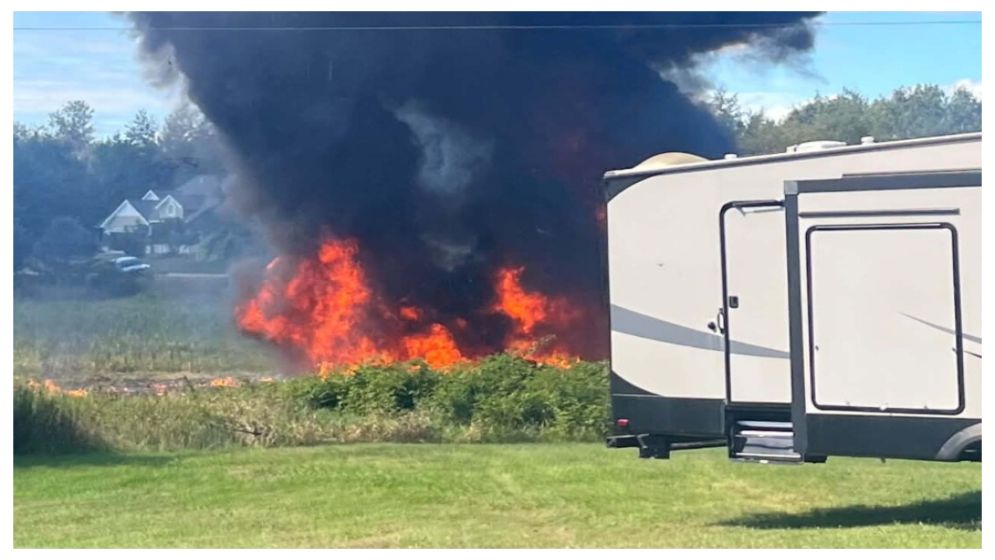
Eyewitnesses near the crash site reported hearing a loud detonation followed by rising plumes of black smoke and a series of secondary explosions in an open field.
Emergency management officials initially issued a shelter-in-place advisory before Michigan State Police enforced a one-mile radius evacuation order. The precautionary measure was taken after hazardous chemicals spilled from the aircraft wreckage.
While state police did not specify the exact substance involved, F-16 fighter jets rely on hydrazine—a highly toxic chemical compound—to fuel the aircraft’s emergency power unit. Grand Traverse County Emergency Management confirmed that the evacuation order was lifted by Thursday evening, allowing residents to return to their properties.
F-16 Safety Record and Investigation
The incident marks the latest in a series of military aviation mishaps involving the F-16 platform, which first entered active service in 1979. According to data from the US Air Force Safety Center, there have been at least 14 “Class A mishaps” involving F-16 jets since 2000—a classification reserved for incidents resulting in over $2 million in property damage, total aircraft destruction, or fatalities.
A formal military board has been convened to evaluate the wreckage and determine the precise sequence of events leading to the crash.
Source: AP
Comment
Design & Developed by: BD IT HOST


 |
18 Septembertember, 2026
|
18 Septembertember, 2026