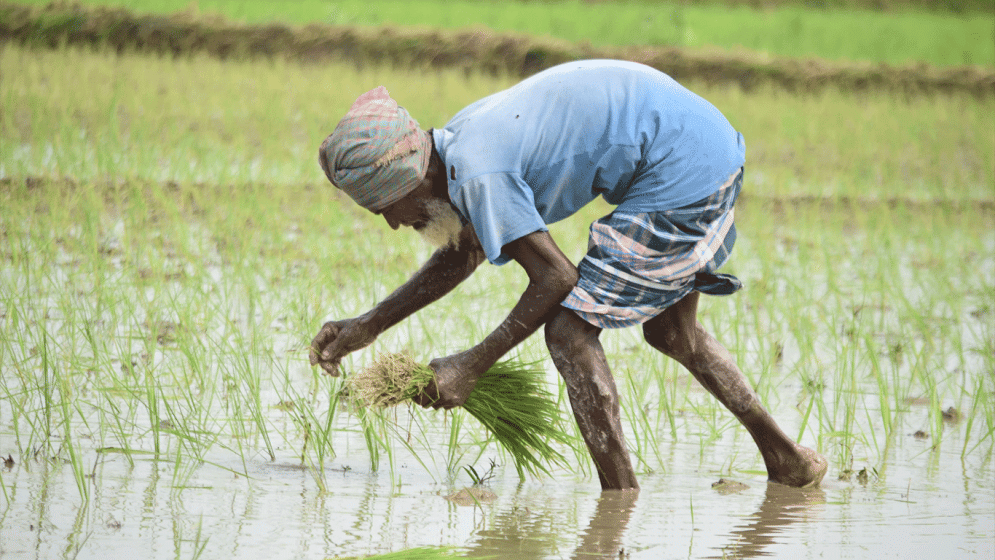
The Aman transplantation, popularly known T-Aman season, is now in full swing across Barind region.
Work begins in rural areas before dawn. Some carry bundles of seedlings to their plots, while others prepare the fields. In many villages, men and women wade waist-deep into the water, working together to transplant the seedlings row by row.
The Rajshahi agricultural region, comprising Rajshahi, Natore, Naogaon and Chapainawabganj districts, has set a target of cultivating Aman paddy on 410,000 hectares this year. As of Saturday, seedlings have been transplanted on around 30% of the targeted land.
According to data from the Ministry of Agriculture, Rajshahi district received higher allocations of three major fertilisers–excluding urea–in July and August this year compared with the same months in 2025.
Amid this seasonal rush, access to fertiliser has become a growing concern.
Farmers say that despite increased government allocations, subsidised fertiliser is often unavailable at authorised dealers at the government rates. They are instead turning to retail shops, where the same fertiliser is being sold at prices far above the official rates.
Visits to several villages and markets in Rajshahi found that subsidised fertiliser was unavailable at many authorised dealer outlets. Yet the same fertilisers were available at nearby retail shops–though at price several hundred taka higher than those fixed by the government.
According to government-fixed prices, a 50-kilogramme sack of triple super phosphate (TSP) sells for Tk1,350, while a sack of diammonium phosphate (DAP) costs Tk1,050. Farmers, however, said that because they could not obtain fertiliser from authorised dealers, they were having to pay Tk1,700–Tk1,800 for a sack of TSP and around Tk1,600 for DAP.
Farmers also alleged that dealers often tell them their stock has run out shortly after opening their shops. In some cases, they said, fertiliser appears to be available if buyers are willing to pay a higher price elsewhere. Retailers also allegedly refuse to issue cash memos for fertiliser purchases.
Roshid Askar and his son Humayun Ali Askar from Baraikuri village in Paba upazila, has an agricultural input card. Roshid said he had visited authorised dealers several times but failed to purchase fertiliser.
“There is no fertiliser at the government-fixed price. But if you are willing to pay more, fertiliser is available,” he said.
At M/S Haque & Sons Enterprise, an authorised Bangladesh Agricultural Development Corporation (BADC) fertiliser dealer at Nowhata Bazar, subsidised fertiliser was unavailable during the visit.
Abdul Haque, proprietor and dealer of the establishment, said he was responsible for supplying fertiliser to several thousand farmers across 42 mouzas. In July, he received only 22 sacks of TSP, 70 sacks of muriate of potash (MOP) and 110 sacks of DAP.
“All of it was sold within two or three days,” he said.
An employee of Tasnim Enterprise, another authorised dealer under the Department of Agricultural Extension, said their fertiliser stock had run out. However, when contacted by phone later, the proprietor of the business, Fazlur Rahman, claimed that fertiliser had been available at the shop.
At a retail shop beside an authorised dealer outlet, the price of a 50-kilogramme sack of DAP was quoted at Tk1,600—Tk550 above the government-fixed price.
The retailer said they collected fertiliser from various sources. According to him, subsidised fertiliser often passes through the hands of several intermediaries before reaching retail shops.
Meanwhile, government data show that fertiliser allocations for the current Aman season have not declined. Rather, allocations have increased in several districts of the Rajshahi agricultural region.
In July 2025, the combined allocation of TSP, DAP and MOP for Rajshahi district was 5,876 tonnes. This year, the allocation increased to 7,033 tonnes.
Allocations also increased in August. TSP rose from 1,430 tonnes to 1,511 tonnes, DAP from 2,404 tonnes to 2,647 tonnes, and MOP from 1,709 tonnes to 1,760 tonnes. Naogaon and Chapainawabganj also received increased allocations, while Natore recorded a slight decline.
The increase in allocations has nevertheless raised questions about why farmers are still struggling to obtain fertiliser at official prices.
Nasir Uddin, assistant director (fertiliser) at the BADC Rajshahi office, said BADC distributes fertiliser according to the quantities approved by the Ministry of Agriculture.
“We cannot supply more than the amount allocated by the ministry,” he said. “Seasonal demand may have increased because some farmers apply fertiliser in quantities higher than the recommended rates.”
Azizur Rahman, deputy director of the Department of Agricultural Extension in Rajshahi division, said he had received no complaints from farmers about a fertiliser shortage.
“Aman transplanting is currently underway everywhere, and agricultural officials are providing farmers with the necessary advice.
“We expect a good Aman harvest this year as well,” he said.
However, the gap between farmers’ direct complaints and the statements of government officials has raised questions about the management of fertiliser distribution at the grassroots level, particularly when fertiliser is reportedly being sold at prices above the government-fixed rates.
Kazi Shahidul Islam, Rajshahi district commissioner and head of the district fertiliser distribution committee, said no farmer had complained to him about being charged excessive prices for fertiliser.
“However, we will look into the matter. If any irregularities are found during the investigation, necessary action will be taken,” he said.
Comment
Design & Developed by: BD IT HOST


 |
9 Augustust, 2026
|
9 Augustust, 2026