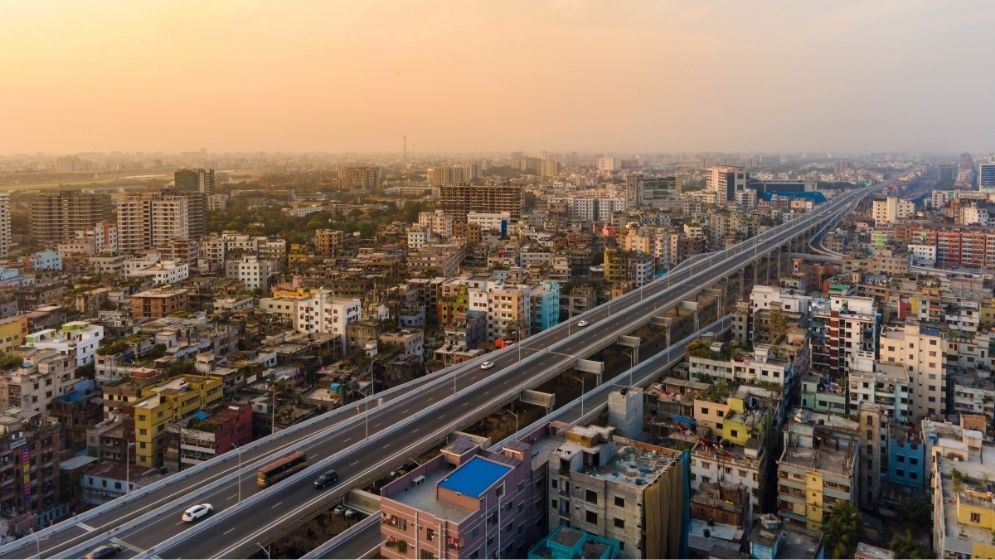
A large part of Dhaka is at serious risk of widespread damage in the event of a major earthquake, as much of the capital has been built on liquefaction-prone soil, experts have warned.
They stressed the need for strict compliance with the Bangladesh National Building Code (BNBC), including proper piling and soil improvement, particularly in high-risk areas before construction begins.
A recent study by Rajdhani Unnayan Kartripakkha (RAJUK) and the Bangladesh University of Engineering and Technology (BUET) found that around 55-60% of Dhaka falls within the red and magenta zones of the city’s liquefaction hazard map, indicating highly vulnerable ground conditions.
Prof Mehedi Ahmed Ansary of BUET’s Department of Civil Engineering said these areas also face high seismic amplification because both hazards are associated with loose or artificially filled soil.
The study found that more than half of the 1,528sq km under RAJUK’s jurisdiction is highly susceptible to soil liquefaction during a major earthquake.
Geologists said Dhaka’s soil, consisting mainly of red Pleistocene clay and soft alluvial deposits, is unsuitable for the city’s dense and largely unplanned urban expansion, raising the risk of widespread structural failure during a powerful earthquake.
Experts recommended proper piling and improving the top five to six metres of soil in high-risk areas to reduce potential damage.
BUET classified Dhaka’s ground conditions into four categories based on the Liquefaction Potential Index (LPI): red (highest risk), magenta (moderate to high risk), blue (lower risk) and green (lowest risk).
Prof Ansary warned that red-zone areas could experience severe ground failure during a magnitude-7.5 earthquake, particularly in places with high groundwater levels near rivers, canals and ponds.
He said sandy fill contributes to both liquefaction and seismic amplification, while soft clay fill mainly increases amplification, making both types of ground hazardous during earthquakes.
Large parts of Dhaka’s expansion along the Balu and Shitalakkhya rivers have been developed on reclaimed or sand-filled land, where construction is possible only after proper soil treatment, he said.
However, developers often avoid such treatment because of the high cost. Proper compaction may require up to ten times more material than loose filling.
“As a result, about 90% of Dhaka’s filled areas rely only on piles without improving the surrounding soil, creating significant risks,” he said.
He cited the 2001 Kandla Port earthquake in India, where a building supported by 60-foot piles tilted because the piles rested in weak, waterlogged soil.
Prof Ansary said techniques such as cement injection, used at the Rooppur Nuclear Power Plant, can significantly strengthen sandy soil.
Without soil improvement, soft upper and lower layers remain vulnerable, causing piles to bend and buildings to tilt during strong tremors, he said.
Neighbourhoods including Old Dhaka, Gulshan, Banani, Dhanmondi, the Dhaka University area, Khilgaon, Motijheel, Farmgate and Mirpur are situated on relatively stronger ground.
In contrast, areas near the Buriganga, Turag, Balu and Shitalakkhya rivers have thick layers of soft clay and recent fill above the stronger red soil, making construction more challenging.
Former Bangladesh Urban Resilience Programme project director Abdul Latif Helali said a soft-soil hazard map had already been prepared, but RAJUK had yet to incorporate it into its planning framework.
RAJUK Chief Town Planner Md Ashraful Islam said the authority received the map after the gazette notification of the Detailed Area Plan (DAP)-2022.
“It is under consideration and will be incorporated when the DAP is updated,” he said.
Liakat Ali Bhuiyan, senior vice-president of the Real Estate and Housing Association of Bangladesh (REHAB), said member developers follow the BNBC to minimise earthquake risks.
He said construction materials, including steel and cement, are manufactured with earthquake resistance in mind.
Following the recent 5.7-magnitude earthquake, REHAB opened a control room but found no damage to member projects.
However, he acknowledged that the impact of a magnitude-7 earthquake would be difficult to predict.
Comment
Design & Developed by: BD IT HOST


 |
28 July, 2026
|
28 July, 2026